thoughts on the Mariners, MLB draft, and more homelinksdraftabout me

The Trouble With Spring Training Battles

Brad Miller remains my pick at shortstop
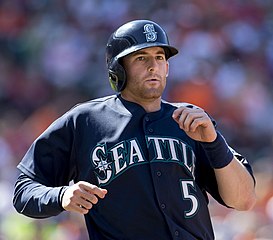
(image credit: Keith Allison, Flickr)
Chris Taylor and Brad Miller are locked in quite the battle to win the opening day shortstop assignment. Miller battled Nick Franklin last year and won, though this year's battle appears more intense so far. Miller clearly outhit Franklin in spring training last year, but Chris Taylor is more than giving Miller a run for his slugging money this spring.

That really should not matter though. Spring training statistics are largely useless. There are two fundamental problems with spring training statistics that compound one another.

First, there are sample size issues. Fangraphs includes in their sabermetrics library a handy guide for when different statistics stabilize - in other words, when stats stop fluctuating enough to suggest a player's underlying talent level. For batters, strikeout rate is the only thing that might stabilize within spring training, and even then a batter would have to play a full 9 innings pretty much every day (which is rare for anyone in spring training). The news is even less rosy for pitchers, where any hurler would need to pitch about 20-25 innings for anything to stabilize. This would mean tossing 5-6 innings regularly every 5 days - again, a fairly rare feat within the confines of spring training.

Still, let's suppose that some batters and pitchers reach large enough sample sizes for a few stats to stabilize. There is still a second significant issue. Spring training competition levels vary wildly from game to game, and even inning to inning. Teams will play split squad games, which means one team may have only half their starters and a bunch minor leaguers ticketed for AA (or lower!) Also, as spring training games progress to later innings, teams often sub out regulars and put in minor league players of interest, particularly early in the spring. So, any batter or pitcher compiling enough time to have their stats stabilize is almost certainly compiling a noteworthy percentage of their stats against minor league competition. The magic marks for statistical stability assume MLB competition 100% of the time so the minor league competition is an issue.

All in all, it is safe to say that there is no realistic way for spring training statistics to honestly reveal a player's underlying talent level. Neil Payne at FiveThirtyEight did an interesting study on spring training stats last year that looks pretty solid in  hindsight, but even his analysis came to a predictable conclusion: players with established track records who take quantum leaps forward or backward in the spring are probably going to be a little bit better or worse than expected, but that's about all that can be said.

Scouting reports on Miller or Taylor should not change in the next few weeks no matter what they do on the field. Perhaps Taylor's batting ability is a bit better than expected, but even making that assumption is haphazard if it is only based on his hitting tear in the Cactus League. Maybe it is a bit more reliable if scouts see something different mechanically in Taylor's swing, or if the Mariners also know something about Taylor's training in the offseason and/or have some measurements that suggest improved bat speed. However, these hypotheticals would still confirm the overall point of this post - spring training statistics say almost nothing on their own.

The M's shortstop battle likely boils down to whether Brad Miller or Chris Taylor fits Lloyd McClendon's vision of a quality MLB shortstop better. I think Chris Taylor ends up winning that battle, and that's based as much on how McClendon used Taylor and Miller down the stretch last season as it is on what has transpired so far in the spring. However, neither Taylor nor Miller has been declared a winner in the battle yet, so McClendon is still analyzing something. It will be interesting to see how he reaches his conclusion and when he reaches it.

2015 Non-Roster Invitee Rankings, Week 2

The early part of the spring wraps up with the first round of cuts, which should come any day now. So, some of these non-roster invitee point totals are about to become final, for better or worse.

A reminder of the point system:
  • 1/3 point for each out (- for hitters, + for pitchers)
  • 1 point for each walk (+ for hitters, - for pitchers)
  • 1 point for each strikeout (- for hitters, + for pitchers)
  • (batters only) 1 point for each total base, 1 point for each stolen base, 1 point subtracted for each caught stealing
  • (pitchers only) 3 points subtracted for each home run allowed
Here are the rankings going into this weekend (total +/-, change in point total from last week)
  1. Tyler Olson (19, +13)
  2. Endy Chavez (13, 0)
  3. Tyler Marlette (12.33, +3.33)
  4. D.J. Peterson (11.83, -0.33)
  5. John Baker (11.67, +2)
  6. Jordy Lara (11.67, +6)
  7. Jordan Pries (11, +5)
  8. Mike Dowd (9.33, -0.67)
  9. Rafael Perez (9.33, +2.33)
  10. Stephen Landazuri (6.67, -0.33)
  11. Patrick Kivlehan (6.5, -7)
  12. Justin Germano (5.33, -2)
  13. Steven Baron (5.17, -0.33)
  14. Franklin Gutierrez (5.08, -0.67)
  15. Mark Lowe (4.67, -1.33)
  16. Shawn O'Malley (3.67, -0.33)
  17. Carlos Rivero (3.33, +1.33)
  18. Sam Gaviglio (1.67, -8.33)
  19. Forrest Snow (-3, -3)
  20. Joe Saunders (-7, -12)
Biggest Rise: Jordy Lara (up 10 spots)
Biggest Drop: Sam Gaviglio (down 14 spots)

The real takeaway from this list and these standings is that the Mariners have about as uninteresting a group of non-roster invitees as imaginable. Tyler Marlette is sitting in third place on the strength of some well-timed singles and stands to be among the first cuts whenever they come. Joe Saunders has been awful enough to lay to rest any suspicions he could grab a left-handed spot in the bullpen. Perhaps Tyler Olson gets himself in the mix with his phenomenal spring, but he profiles as rotation depth. In reality he's auditioning for a call-up midseason if/when injuries hit. He is the non-roster story of the spring to this point though - a true darkhorse, unlike more heralded prospects like D.J. Peterson and Patrick Kivlehan (who have also made solid accountings for themselves).

This list should naturally separate some more as players get cut and players on the bubble of making the roster get more playing time. The points system is designed to favor "compilers," which in other words means players that play more should be able to earn higher point totals.

2015 Non-Roster Invitee Rankings, Week 1

The Mariners have only played three spring training games so far, but that's plenty enough to overreact to the results! I will update the non-roster invitee rankings every Friday until spring training is over. Already there is quite a bit of movement.

First of all, here's how players earn and lose points:

  • 1/3 point for each out (- for hitters, + for pitchers)
  • 1 point for each walk (+ for hitters, - for pitchers)
  • 1 point for each strikeout (- for hitters, + for pitchers)
  • (batters only) 1 point for each total base, 1 point for each stolen base, 1 point subtracted for each caught stealing
  • (pitchers only) 3 points subtracted for each home run allowed
After three whole games here are the updated standings (point total, change from last week):
  1. Patrick Kivlehan (13.5, +9)
  2. Endy Chavez (12.33, -0.67)
  3. D.J. Peterson (12.17, +5.67)
  4. Sam Gaviglio (10, +4)
  5. Tyler Olson (10, +4)
  6. Mike Dowd (10, +4)
  7. Tyler Marlette (9, +2)
  8. John Baker (8.33, -1.67)
  9. Justin Germano (7.33 , +0.33)
  10. Rafael Perez (7, -1)
  11. Stephen Landazuri (7, 0)
  12. Mark Lowe (6, -1)
  13. Jorden Pries (6, 0)
  14. Franklin Gutierrez (5.75, -1)
  15. Steve Baron (5.5, 0)
  16. Jordy Lara (5.33, -0.67)
  17. Joe Saunders (5, -5)
  18. Shawn O'Malley (4, 0)
  19. Carlos Rivero (2, -3)
  20. Forrest Snow (0, -5)
Biggest Rise: Patrick Kivlehan (up 18 slots)
Biggest Drop: Joe Saunders (down 15 slots)

Kivlehan's 3-run home run is easily the most exciting thing a non-roster invitee has done in the first three games of the spring. Already, even with the initial point spread, every player who gained points in the first three games find themselves in the top half of the standings. Maybe the most interesting thing is to see John Baker leapfrogged (at least for the time being) by some non-roster catchers who will clearly get cut as the pitching staff gets thinned. Ultimately that is probably good news for Jesus Sucre's chances at an opening day roster spot.

But really, this is a for-funsies ranking system three games into an exhibition system. If this is what three games can do, we can only imagine what a whole week of games will do.