thoughts on the Mariners, MLB draft, and more homelinksdraftabout me
Showing posts with label Brad Miller. Show all posts

Crazy Legs for Boog (and Others): Offseason Begins Unexpectedly

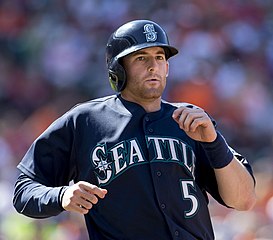
Brad Miller
(Flickr via Wikimedia Commons, Keith Allison)
Jerry Dipoto consummated his first deal as Mariners GM, a six-player swap with the Rays. It also doubles as the first transaction of the offseason made by any team. The trade is (probably) not star-studded, but nonetheless and interesting six-player deal that raised some eyebrows. The blow-by-blow recap:

Rays acquire:

  • RHP Danny Farquhar - Lord Farquhar was a revelation in 2014, and really near the end of 2013 too. He combined a 96-mph heater with a very good cutter and racked up strikeouts at a prolific rate. However, Farquhar struggled mightily last season and shuttled between Seattle and Tacoma a bit. Farquhar could regress next year, which for him means improving to his 2014 form, but his inclusion in this deal suggests that Dipoto saw him as fringy depth.
  • SS? Brad Miller - Crazy legs is clearly the key piece in this deal, and in all likelihood the best player of all six traded. However, Miller's value is hard to judge, and his trade value is especially mysterious. Miller is a polarizing player because of his skillset. He has gap power, nice speed, and just enough contact and plate discipline to be a respectable hitter. This is a tremendous combination for a shortstop, but opinions of Miller's defense at shortstop vary wildly. Some think he is awful and must move off the position immediately. Others point to data like UZR and suggest that he his at least league average. An average defender at short with a league-average bat is a borderline all-star. An average defender in left field with an average bat is a fringe starter. So, a team who sees Miller as a shortstop would value him much more than a team who thinks he must move off the position. Any team acquiring Crazy Legs likely sees him as a shortstop, but also likely knows that he should come at a bit of a reduced price because other teams would have no interest in him. I always liked Miller as a shortstop so his inclusion in this trade his hard for me to stomach. More on this in the analysis to follow.
  • 1B Logan Morrison - Frankly, I view LoMo as less than a throw-in. He penciled in as a bench bat slated to make around $4 million in arbitration. There was little doubt in my mind that Dipoto would get rid of him one way or another. The Mariners collected way too many 1B/DH types under Jack Zduriencik. The $4 million man most likely to sit on the bench many days was a very logical guy to go.
Mariners acquire:
  • RHP Nate Karns - Karns fits the Dipoto mold. He is a hard-throwing righty that racks up strikeouts, along with a disproportionate amount of home runs. Whether his high home run rate is an unsustainable fluke or an underlying flaw in his game remains to be seen. Either way, Safeco Field is likely to mask this problem. At worst, Karns is a serviceable starting pitcher under cheap team control for several years. At best, he could take a step forward and be a legitimate mid-rotation starter.
  • CF Boog Powell - Powell also fits the Dipoto mold, or at least the vision he shared of his kind of Safeco Field team. Powell has little power to speak of, but has exhibited great patience, plate discipline, and contact ability throughout the minors. Moreover, scouting reports suggest that Powell can serviceably defend all three outfield positions. Powell's skillset screams marginal MLB talent, but his specific things he is good at are things that were virtually non-existent on the Mariners roster.
  • LHP C.J. Riefenhauser - A lefty reliever yet to do much in the majors (albeit in limited opportunities), Riefenhauser has been productive in the minors and has lots of years of team control remaining. The lengthy team control is probably his greatest asset, though he is also highly likely to log some time in the M's bullpen in 2016.
It is easy to look at this trade and be disappointed in Dipoto and the Mariners. Farquhar, Miller, and Morrison all logged significant time with the Mariners the last two years. Only Karns has done much of anything in the majors among the trio the Mariners receieved. Also, Farquhar, Miller, and Morrison were among the Mariners more interesting, charismatic players. Brad Miller with his crazy legs and gorgeous stirrups, Farquhar with his brutal honesty in interviews (like saying he was sent down because he sucked), and LoMo with things like running to the mound and asking Fernando Rodney where his arrow went. I simply enjoyed the presence of the players the M's got rid of in this trade, and the players received are, at least at the moment, so anonymous.

I am glad I waited a day to write this post though. The deal has grown on me considerably in the past 24 hours. It is a tad risky, but makes good sense, especially when some hidden assets in the deal are considered.

The Mariners needed some team-controlled, cost-controlled depth. Robinson Cano, King Felix, and Kyle Seager are all signed for $100+ million for the next several years. Nelson Cruz is not exactly cheap either and has three years remaining on his deal. The Mariners have to count on these players being the core of their team. However, the Mariners won't win with this core if they cannot assemble decent talent around them, and that talent will have to come on a budget. These players do not need to be stars, but they need to be complimentary pieces at reasonable prices - in other words, decent players who are years short of hitting free agency.

Boog Powell has 6 years of team control remaining. His MLB clock hasn't started. Riefenhauser has at least 5 years of team control. Karns has at least 4. LoMo had 1 year of team control left, Farquhar and Miller were at 3 or 4 apiece. The Mariners added several years of cheap, team-controlled talent in this trade, which cannot be ignored in the overall valuation of this deal. In fact, the gap in team-controlled years involved in this trade is large enough to expect the Mariners needed to give up more talent to offset this gain - and pursuing decent players with lots of team-controlled years, given the current structure of the Mariners payroll, is somewhere between wise and necessary.

So, Danny Farquhar is probably a more talented reliever than C.J. Riefenhauser. However, I would argue he is a less valuable overall asset. Riefenhauser is left-handed with a couple more years of team control. If both Farquhar and Riefenhauser project as bullpen depth - either in middle relief in the majors or as one of the first call-ups from Tacoama - taking the guy with more cheap, team-controlled years is a no-brainer. The talent gap doesn't matter as much as the millions of dollars that can be spent somewhere else.

Similarly, this is why Logan Morrison could almost be considered a liability for the Mariners. He projected to have marginal playing time at best*, with only one year of team control remaining, and a relatively pricey year given his projected role. LoMo's lumbering lefty power would have been nice to have stashed away on the bench, but LoMo as an overall asset did not make much sense for the 2016 Mariners. The price point and lack of team control are not good fits at all.

*Assuming Mark Trumbo plays first base, which seems especially safe with this trade.

Ultimately, this all suggests that the talent gap between Brad Miller and the combination of Nate Karns and Boog Powell has to be substantial before this deal turns out bad for the Mariners. There is room for Miller to blossom for the Rays and for the Mariners to still be better for making this trade. 

The deal is even less likely to turn out bad given the complexion of the Mariners roster. They desperately needed capable defensive outfielders and some plate discipline, the two things Zduriencik completely ignored the last few years as he horded ALL THE DINGERS FOREVER. Boog Powell has plate discipline and outfield defense. It remains to be seen if Powell's skills are strong enough to carve out a legitimate spot in the majors, but he at least possesses skills the Mariners sorely lacked. 

As for Karns, he will help eliminate the need to stretch out relievers to start, which is what the Mariners ended up doing after the All-Star break (Vidal Nuno, Edgar Olmos, and even Tony Zych for one start). Rotation depth was absolutely necessary, especially with Hisashi Iwakuma as an impending free agent.

At worst, the Mariners got a little depth with lots of cheap, team-controlled years. At best, they got themselves a nice mid-rotation starter and an everyday centerfielder who could also be an effective leadoff hitter. Dipoto's comments suggest that he believes he got the latter, not the former, which makes it easy to see why he would part with Brad Miller. I think Dipoto is looking through this trade with rose-tinted glasses based on his comments, but even an outcome noticeably short of Dipoto's vision is still one worth making.
The Trouble With Spring Training Battles

Brad Miller remains my pick at shortstop
(image credit: Keith Allison, Flickr)
Chris Taylor and Brad Miller are locked in quite the battle to win the opening day shortstop assignment. Miller battled Nick Franklin last year and won, though this year's battle appears more intense so far. Miller clearly outhit Franklin in spring training last year, but Chris Taylor is more than giving Miller a run for his slugging money this spring.

That really should not matter though. Spring training statistics are largely useless. There are two fundamental problems with spring training statistics that compound one another.

First, there are sample size issues. Fangraphs includes in their sabermetrics library a handy guide for when different statistics stabilize - in other words, when stats stop fluctuating enough to suggest a player's underlying talent level. For batters, strikeout rate is the only thing that might stabilize within spring training, and even then a batter would have to play a full 9 innings pretty much every day (which is rare for anyone in spring training). The news is even less rosy for pitchers, where any hurler would need to pitch about 20-25 innings for anything to stabilize. This would mean tossing 5-6 innings regularly every 5 days - again, a fairly rare feat within the confines of spring training.

Still, let's suppose that some batters and pitchers reach large enough sample sizes for a few stats to stabilize. There is still a second significant issue. Spring training competition levels vary wildly from game to game, and even inning to inning. Teams will play split squad games, which means one team may have only half their starters and a bunch minor leaguers ticketed for AA (or lower!) Also, as spring training games progress to later innings, teams often sub out regulars and put in minor league players of interest, particularly early in the spring. So, any batter or pitcher compiling enough time to have their stats stabilize is almost certainly compiling a noteworthy percentage of their stats against minor league competition. The magic marks for statistical stability assume MLB competition 100% of the time so the minor league competition is an issue.

All in all, it is safe to say that there is no realistic way for spring training statistics to honestly reveal a player's underlying talent level. Neil Payne at FiveThirtyEight did an interesting study on spring training stats last year that looks pretty solid in  hindsight, but even his analysis came to a predictable conclusion: players with established track records who take quantum leaps forward or backward in the spring are probably going to be a little bit better or worse than expected, but that's about all that can be said.

Scouting reports on Miller or Taylor should not change in the next few weeks no matter what they do on the field. Perhaps Taylor's batting ability is a bit better than expected, but even making that assumption is haphazard if it is only based on his hitting tear in the Cactus League. Maybe it is a bit more reliable if scouts see something different mechanically in Taylor's swing, or if the Mariners also know something about Taylor's training in the offseason and/or have some measurements that suggest improved bat speed. However, these hypotheticals would still confirm the overall point of this post - spring training statistics say almost nothing on their own.

The M's shortstop battle likely boils down to whether Brad Miller or Chris Taylor fits Lloyd McClendon's vision of a quality MLB shortstop better. I think Chris Taylor ends up winning that battle, and that's based as much on how McClendon used Taylor and Miller down the stretch last season as it is on what has transpired so far in the spring. However, neither Taylor nor Miller has been declared a winner in the battle yet, so McClendon is still analyzing something. It will be interesting to see how he reaches his conclusion and when he reaches it.

Imagining Brad Miller as a Center Fielder

The A's grabbed Ben Zobrist over the weekend, but I didn't strike while the iron was hot on that one so I won't write a whole post. Hot Mariners Musings take: the Oakland A's got better (SHOCKING ANALYSIS). In fact, the A's got so much better with that trade that I'm not sure they are any worse than they were last season, which is pretty incredible when you think about it. They traded the farm for Jon Lester and he walked away as a free agent this offseason.

There are also rumors popping up that the Astros are close to acquiring Evan Gattis. Perhaps that will warrant a full post if/when it happens. Houston is coming, sooner or later, and a move like acquiring Gattis would move up the time table. I like Gattis as an M's target, but after Nelson Cruz signed he made less sense.

The Mariners feel like they are falling behind in the AL West arms race at the moment, but it's hard to see a free agent signing or major trade that makes great sense at this point. The M's have a ton of money sunk in King Felix, Robinson Cano, and now Kyle Seager, plus several prospects (read between the lines: very cheap talents) that have recently pushed into the majors. The best outcome for the 2015 Mariners is for some of these prospects to reach their potential and match the value other AL West foes are adding via free agency, and especially as of recently, trades.

Interestingly, or perhaps unfortunately, two of the M's more intriguing young players both play shortstop. Chris Taylor and Brad Miller seem poised for a battle with the loser ticketed for AAA Tacoma. While I, as a Rainiers fan, would welcome either in Tacoma, there is little doubt in my head an inferior position player would stay over either Miller or Taylor unless the Mariners get creative.

Brad Miller (wikimedia commons, uploaded by UCinternational,
originally posted on Flickr by Keith Allison)
So, I have a proposal. Brad Miller should try his hand at center field.

Let me start by saying that Miller gets mixed reviews for his defense at shortstop, but I personally like his defense. Few doubt his range or arm strength, but some think he would make fewer errors at this point in his career if he was a viable MLB shortstop. These same concerns do not dog Chris Taylor - both statistically and in more traditional scouting reports. Taylor is rather clearly the superior defender between the two, so I opt to keep him at shortstop.

The Mariners already have Austin Jackson in center field, but that only makes me more comfortable with a Brad Miller transition. Jackson is only under contract through 2015, and after his lackluster performance to finish last season, there is no reason to expect him to be a long-term solution. While I like Jackson's chances to rebound, and hope he does, the Mariners would be wise to create contingency plans. Right now, there best (and only) option is James Jones, who so far looks like a center fielder but doesn't produce like much more than a fourth outfielder at best.

Miller is a better hitter than Jones, and probably even a better hitter than Austin Jackson. Also, his arm and range at shortstop could very well transfer nicely in the center field as he learns to run clean, precise routes. Route-running is still an underrated skill (at least in my opinion), but I would be willing to bet on Brad Miller's athleticism hiding some of his mistakes as he learns.

Some thought a corner outfield spot would make sense for Brad Miller because of where the Mariners had holes until they acquired Justin Ruggiano and Seth Smith. I never liked that idea because it killed Brad Miller's value. So much of what makes him intriguing has to do with the position he plays. Simply put, there are more good hitters at first base than at shortstop, and tools like WAR account for this specific. Fangraphs publishes their positional adjustments, and using those as a rule of thumb illuminates the problem with moving Brad Miller to a corner outfield spot. Miller, even if he could man a corner outfield spot as well as he mans shortstop, would be worth 15 runs less than if he offered the same level of production at shortstop. That's approximately worth 1.5 wins, and Miller clocked in as a 1.4 fWAR player in 2014. Miller would literally go from a borderline everyday player to replacement level. That's a big difference.

However, Miller would lose only 5 runs in positional adjustment from shortstop to center field (a 0.5 WAR drop). In other words, the difference between Miller switching to center field instead of left or right field is a full win. Now, this is because center field is harder to play, so theoretically Miller's defense would suffer more in center field more than a corner. However, I am skeptical his metrics would be all that different. The reality is that Miller hasn't played any outfield, and the main difference between center and the corners is the range they demand. I'm bullish on Crazy Legs's ability to canvas the spacious grass of Safeco.

Moreover, the Mariners have more corner outfield prospects. Patrick Kivlihen isn't that far away and gets more intriguing every year. Maybe Stefen Romero still becomes something. Alex Jackson, though still very young, could progress through the system fast. We could be talking about him and Austin Wilson appearing in Safeco within a few years. Maybe Gareth Morgan follows a little after both of them. All of these players are corner outfielders.

If the Mariners carry Brad Miller as a centerfielder in training, the roster could look something like this:

STARTERS

  • C: Mike Zunino
  • 1B: Logan Morrison
  • 2B: Robinson Cano
  • SS: Chris Taylor
  • 3B: Kyle Seager
  • LF: Dustin Ackley
  • CF: Austin Jackson
  • RF: Seth Smith/Justin Ruggiano (but mostly Smith as the lefty in the platoon)
  • DH: Nelson Cruz
BENCH
  • Jesus Sucre (C)
  • Willie Bloomquist (infield)
  • Brad Miller (centerfielder)
  • Seth Smith/Justin Ruggiano (depending on who isn't starting)
Ruggiano can play center fielder if needed, so it would be about impossible for Brad Miller to ever be the only center fielder available in a massively critical situation, barring some really poor managing. He would provide some speed and a jolt of offense on the bench, and could DH also, so it's not like the Mariners would be playing with only 24 players. If/when LoMo gets injured, the Mariners could toy with letting Dustin Ackley play first base, deploying Ruggiano and Smith in the corner outfield slots (bumping Miller a bit closer to center field playing time), and calling up James Jones for added depth (because LoMo would be on the DL in this scenario).

The Mariners roster, both in 2015 and beyond, balances out and works better if one of their shortstops can transition to center field. Both Taylor and Ketel Marte (flying under the radar, but not for much longer) profile as prototypical shortstops who glean much of their value from how the field the most demanding position in baseball. Brad Miller, by contrast, is more of an intriguing blend of athleticism and hitting ability that might be able to stick at a premium defensive position. I'd like to see what he can do shagging flies in the Cactus league and go from there. It could work out well for him and the Mariners. It's a way to help the Mariners keep their 25 best players on the MLB roster while also shoring up the long-term outlook of the roster.

Cuts Galore; Roster Taking Shape

A couple rounds of cuts this week leave the Mariners with 40 players left in camp. First, the cuts:

INEVITABLE: C Mike Dowd, C Jesus Sucre, 1B Ji-Man Choi, "1B" Jesus Montero, INF Carlos Triunfel, INF Ty Kelly, INF Chris Taylor, INF Nate Tenbrink, OF Xavier Avery, LHP Nick Hill, RHP Logan Bawcom, RHP Logan Kensing, RHP Matt Palmer

No offense to anyone in the "inevitables." Several of them have potential MLB careers. These were all players on the wrong side of the numbers game and more or less around for the experience of big league camp until it was time to get serious.

SOMEWHAT INTERESTING: LHP Bobby LaFramboise, OF James Jones

I though LaFramboise might have a chance to crack the opening day roster since Oliver Perez is now in Arizona. I thought that James Jones would eventually get cut but not for a while longer with all the playing time he got. I'm actually relieved Jones got cut at this point because I wondered if Lloyd McClendon was too in love with him. He has things to learn in the minors.

So who will make the team?

ON THE DL: Hisashi Iwakuma, Taijuan Walker, maybe Stephen Pryor (still recovering from last season). That brings us down to 37 players.

LOCKS (18): C John Buck, C Mike Zunino, 1B Justin Smoak, 2B Robinson Cano, 3B Kyle Seager, INF Willie Bloomquist, OF Dustin Ackley, OF Corey Hart, OF Logan Morrison, OF Michael Saunders, LHP Charlie Furbush, RHP Scott Baker, RHP Danny Farquhar, RHP Felix Hernandez, RHP Yoervis Medina, RHP Erasmo Ramirez, RHP Fernando Rodney, RHP Tom Wilhelmsen

I know Scott Baker is a non-roster invitee, but he just got moved from a start against the Angels to play in a minor league game. The M's open up the season against the Angels, and Baker has already faced them twice. Doubtful these facts have nothing to do with the change.

The remaining battles:

Shortstop: Brad Miller vs. Nick Franklin - I guess this is a battle because the Mariners say it is. Brad Miller should have been the favorite coming into the spring, and even if he wasn't he's had a very good spring that should shore up his standing. I almost included Miller as a lock. Nick Franklin will go to AAA unless/until he is traded.

Capable centerfielder on the bench: Abe Almonte vs. Endy Chavez - The cuts have at least made this battle clear, unless you also believe Cole Gillespie could play center field regularly. Quite honestly, I almost made Almonte a lock for this spot because he's already on the roster and Chavez quietly slipped to below replacement level last season and he's not getting any younger.

Fourth and fifth starters in the rotation: LHP James Paxton, LHP Randy Wolf, RHP Blake Beavan - I think Paxton nearly has a rotation spot nailed down given the control he's shown this spring. Beavan and Wolf are in an interesting duel though...or sort of interesting, at least. The reality is that the whoever wins this spring training battle will get booted from the rotation once Taijuan Walker or Hisashi Iwakuma is healthy, and neither project to sit out a ton of starts to begin the season. Still, Wolf vs. Beavan is at least too close to call. Beavan has outperformed Wolf, for what it's worth, but Wolf is more experienced and left-handed.

Bullpen lefty: Lucas Luetge vs. Joe Beimel - Again, younger guy verses veteran, though in a more limited role on the team. No idea how McClendon will choose with this one, though I'd simply stick with Luetge since he's already on the 40-man roster and Beimel isn't.

The last bullpen slot: This position could go to the odd man out in the rotation race or one of the remaining righties I am about to talk about. Both Zach Miner and Dominic Leone have appeared five times, which is tied for the most appearances by any M's pitcher this spring. It's a seven-way tie, so I don't want to make that too big of a deal, but playing time suggests that McClendon wants to see these guys for some reason. They have both done well for themselves, though I still like Carson Smith even more and he has performed very well in his 3.2 innings.

If you count up all the players you'll realized I totally ignored some that are still in camp. Those are folks I expect to go sooner rather than later.

There simply aren't interesting battles in camp this spring, unless you count the faux battle between Brad Miller and Nick Franklin. The other reality is that the winners of these battles simply get the first crack at the job and there will be movement during the season. We already know Iwakuma and Walker will be coming back, likely before April is over.

Still, there is something special about an opening day roster, and most positions have gone from an unruly glut to a few extra names after this week's cuts. The 2014 Mariners are taking shape.

Future Is Almost Now

The Mariners went farther than sending Jesus Montero down and promoting Jesus Sucre. They also DFAd Robert Andino and promoted Carlos Triunfel to the majors. I'd imagine Triunfel will take some playing time away from Brendan Ryan, but now that Ryan's batting average is over .200 who knows! Anything is possible.

What's most interesting about all these moves is who took Triunfel's place in Tacoma. Brad Miller got promoted from AA Jackson, and will presumably be the new starting shortstop for the Rainiers.

Media attention in Tacoma will probably swirl around Montero's transition to first base, but I'm here to tell you there are way, way more interesting scenarios brewing in Tacoma right now.