thoughts on the Mariners, MLB draft, and more homelinksdraftabout me

Mariners Acquire Seth Smith, Erasmo Ramirez Watch Begins

The Seth Smith watch is officially over now that Seth Smith is a Seattle Mariner. The Padres shipped him to Seattle for Brandon Maurer.

This looks like a win-win deal. San Diego was in the market for bullpen help so the Mariners matched up very nicely with them. Maurer has a great arm that, out of the bullpen, rushes the ball up to the plate near 100 miles an hour. He also has some tantalizing secondary stuff, particularly a slider that sits near 90 mph. There are likely still some people who think Maurer could develop into a starter, but I gave on that dream several horrid showings ago. Still, he deserves to be in an MLB bullpen and it was hard to find him a spot in the M's loaded unit.

Smith, as I noted a few weeks ago, is a terrific platoon partner for Justin Ruggiano. Since Smith will be the platoon partner facing righties he will see more playing time, which allows Ruggiano to be a quasi reserve outfielder. His decent speed and defense could be assets off the bench.

The Mariners look quite a bit like a finished team at this point. Some want a strong backup for Logan Morrison at first base, and that would make some sense. However, it's pretty clear that DJ Peterson is the future at first base, and that future could come as early as this summer if needed. In the meantime, there are some promising reports on Jesus Montero this offseason. Perhaps he is enough of a stopgap if needed. Personally, I won't be disappointed if the Mariners roll the dice with LoMo and the first base options they have right now...

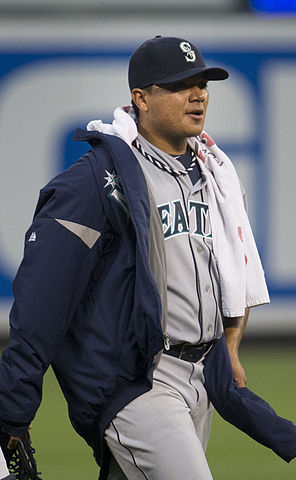
Erasmo Ramirez (UCinternational, Wikimedia
Commons via Keith Allison, Flickr)
...with one exception. I would offer Erasmo Ramirez to the Red Sox for Allen Craig and see what they say. Ramirez is out of options and doesn't have a clear spot on the Mariners roster, particularly with the addition of J.A. Happ. Boston signed guys like Justin Masterson to one-year deals to fill out their rotation and have a glut of hitters on their roster now after signing both Hanley Ramirez and Pablo Sandoval. So, a Ramirez-for-Craig swap might make some sense for both sides. Craig also has experience playing the outfield, which would be a plus for the Mariners roster. The problem with Craig is his fast decline the past few years. The drop might be injury-related, and if it is he is a candidate for a strong comeback. However, at this point the Mariners can afford to take the risk because of the other hitters they have already acquired this offseason.

Here's how the M's roster could look with Allen Craig in the fold:

Starters
C Mike Zunino, 1B Logan Morrison, 2B Robinson Cano, SS Brad Miller, 3B Kyle Seager, LF Dustin Ackley, CF Austin Jackson, RF Seth Smith/Justin Ruggiano, DH Nelson Cruz

Bench
C Jesus Sucre, INF Willie Bloomquist, 1B/OF Allen Craig

Rotation
Felix Hernandez, Hisashi Iwakuma, J.A. Happ, James Paxton, Taijuan Walker

Bullpen
Fernando Rodney, Charlie Furbush, Tom Wilhelmsen, Danny Farquhar, Yoervis Medina, Dominic Leone, David Rollins

Depth in minor leagues
SS Chris Taylor, 1B Jesus Montero, 1B DJ Peterson, OF James Jones, OF Stefen Romero, LHP Roenis Elias, RHP Carson Smith

This is all hypothetical, and there are some spring training battles brewing (those battles are for future posts), but the picture and festering issues are clear enough. Even with Erasmo Ramirez out of the picture it's virtually impossible to find a way for a few quality arms to make the Mariners roster. Even if they don't keep Rollins, their rule 5 pick, that still leaves a guy like Carson Smith in Tacoma.

I don't see a great fit for Erasmo Ramirez on the Mariners roster, but I think he has value to other teams. So, since I feel emboldened by the Seth Smith watch, I hereby declare that the Erasmo Ramirez watch has begun. Trading Ramirez is not as blatantly obvious of a move as acquiring Seth Smith, but it's obvious enough to watch for it. What's more interesting is who the Mariners might get in return. I would go after Allen Craig but I suppose we will see what does (or doesn't) happen.

Just How Cramped is the 2015 Hall of Fame Ballot?

It's that magical time of the year where Hall of Fame voting occurs, which in recent memory has been the annual battle to get Edgar Martinez's incredible hitting accomplishments recognized. Edgar is my favorite player ever - a title he has a good chance of holding my whole life - so I am heavily biased. My love of him has probably only increased with the Hall of Fame battle he finds himself in. Others, such as the incomparable Jay Jaffe, bang the drum for Edgar every year, so I won't repeat my case for him.

However, Edgar's predicament has driven me to investigate the Hall of Fame in much more detail than ever before. This year's ballot is noted for how bloated it is, and I decided to see if it really is as clogged as many claim.

I started my investigation with a basic premise. There are two basic ways to get to the Hall of Fame: compile all-time great numbers over a long career, or without the counting stats, have an amazing peak that compares with the all-time greats. Career WAR can measure the compilers, and a simple best single-season WAR goes a long way towards describing a player's peak. Essentially, I approximated Jay Jaffe's JAWS stat by splitting it into its two core parts and treating those parts as an ordered pair. Below are the results:

Career bWAR vs. Single-season best bWAR
Current HOF (blue) and 2015 Candidates (red)


To start with, I was surprised at how compact the data is. I expected less of a relationship; in other words I expected more diversity (some players with mediocre peaks that played forever and some players without great careers that had absurd peaks). I do not know how much of this behavior is due to voting preference, but I would expect quite a bit of it. Anecdotally, different voters prefer different Hall of Fame sizes and different kinds of Hall of Fame careers, but a general consensus is forced by requiring 75% of ballots to name someone a Hall of Famer.

It's somewhat hard to see with the naked eye, but the relationship between season best and career WARs is more logarithmic than linear. That means career bWARs increase exponentially faster than single season bests with increasing larger bWAR totals. This phenomena is likely caused by a couple factors. First of all, it might be possible for a player to only be so phenomenal in one season, and all-time greats stay at that level longer than other players. This would result in a career bWAR that compiles every larger without creating a new standard for a season best bWAR. The second option is that Hall of Fame voters favor career accomplishments over phenomenal peaks at a predictable rate. I haven't looked into non-Hall of Famers, but that might be an interesting study to do at some point. My guess is that the relationship in this graph is caused more by the limits of how good a player can be than any voting bias.

Simple looking at the graph with a naked eye it's easy to identify four obvious Hall of Famers - Barry Bonds, Roger Clemens, Randy Johnson, and Pedro Martinez. Bonds and Clemens remain mired in PED purgatory, which creates the initial problem with this year's ballot. In normal circumstances Bonds and Clemens would have sailed into the Hall of Fame on the first ballot, but now their vote totals (or lack thereof) provide a barometer every year for how tolerant the voting bloc is of steroid use at the turn of the millenium.

Johnson and Martinez are newcomers to the ballot, neither with PED controversy around them, so they should theoretically sail through this year, emphasis theoretically.

The Big Unit's career, at least by peak and career WAR totals, is most similar to the likes of Tom Seaver, Lefty Grove, and Christy Mathewson, which is quite the trio. Mathewson went in as part of the first HoF class ever. Tom Seaver was also a first-ballot Hall-of-Famer and still holds the record for highest percentage of ballots (98.8%). Lefty Grove, though comparable to these pitchers, made it to the Hall in his fourth year of eligibility. So, who knows what kind of vote total Randy Johnson will end up with, but he's a strong candidate for enshrinement on his first try.

Pedro Martinez has two remarkably similar peers in the Hall of Fame already, Bob Gibson and Fergie Jenkins. Gibson went in on his first ballot with 84% of the vote, and Jenkins made it on his third try. It seems like many think Pedro is a given to make it on his first try, but I am not so certain. I agree that he should go in on his first try, but his case rests on a tremendous peak with nice, but not legendary, career totals. Neither Gibson nor Jenkins seem like borderline Hall of Famers at this point, but when they were voted on neither garnered phenomenal vote totals. Perhaps Pedro gets more votes than either of them because his iconic seasons came in the heat of the PED era, making him the first to get a bump from the era instead of a penalty, but Hall of Fame standards also keep escalating. I am curious to see Pedro's vote total, and I don't consider him a shoo-in to make it on his first try.

After that, there are lots of red dots on the chart well within the pack of "typical" Hall-of-Famers. Easily more than 10 dots, which speaks to the crowded ballot. It will simply be hard for players to get to the 75% line with so many viable candidates to choose from. So, theoretically, the players most "central" on the graph have the best chance - those who had both high peaks and lengthy careers. They have the kind of candidacies which should appeal to a broad enough swath of voters to cut through the backlog and make it into Cooperstown.

I found the median career bWAR for a Hall of Famer, and the median peak bWAR for a Hall of Famer, and then divided each individual player's WAR totals by the median to get a scaled score of how good they are relative to other Hall-of-Famers. Any number over 1 represents a player with a WAR total better than the Hall of Fame median. Below is the list of players who have above-average peak and career bWAR totals on this year's ballot, with their overall score (both peak and career scaled totals added) and their percentage on last year's ballot:

  1. Barry Bonds (4.1, 34.7%)
  2. Roger Clemens (3.8, 35.4%)
  3. Randy Johnson (3.0, N/A)
  4. Pedro Martinez (2.8, N/A)
  5. Larry Walker (2.4, 10.2%)
  6. Curt Schilling (2.4, 29.2%)
  7. Mike Mussina (2.4, 20.3%)
  8. Jeff Bagwell (2.3, 54.3%)
  9. Craig Biggio (2.2, 74.8%)
  10. Alan Trammell (2.2, 20.8%)
Only Pedro Martinez and Randy Johnson are newcomers to this list, which is mind-boggling when you think about it. These are players who had more productive careers AND better individual seasons than the CURRENT MEDIAN HALL-OF-FAMER. None of these 10 players should even be borderline cases - no matter a voter's preference for long-term success or a high peak - yet only two of the eight on this list that were on last year's ballot got over 50%. In fact, both Walker and Trammel seem likely to fall off the ballot altogether without sniffing enshrinement. Furthermore, only Bonds and Clemens have legitimate PED implications, though it seems that Jeff Bagwell has been lumped in with the PED crowd just because a bunch of voters feel like it.

It's lazy to blame the current glut on PED use. The steroid era certainly contributes, but the voting bloc has largely passed judgement already. Bonds and Clemens would already be Hall of Famers with well over 90% of the vote if not for steroid use. So, based on their vote totals, roughly 2/3 of voters won't even consider a steroid user no matter their career accomplishments - more than enough to keep any confirmed steroid user out of the Hall of Fame, and enough to have already cleansed the ballot of many PED users.

For fun, let's say that absolutely nobody voted for Bonds and Clemens on the 2015 ballot and instead put all their votes towards another player on the ballot. Only Biggio and Bagwell would get big enough boosts to make the Hall. Everyone else would still fall short,* even though nobody else with more than 20% of votes has PED suspicions in their past.

*Assuming that everyone who voted for Clemens also voted for Bonds, meaning there aren't 70% worth of votes to go around, but more like 35%. I would argue this is an extremely reasonable assumption.

The BBWAA, subconsciously, has turned into a club characterized by grumpy, cantankerous old men who I am convinced did not even watch the careers of most players on today's Hall of Fame ballots, and certainly does not bother to look at the production they accumulated over their illustrious careers. How else can some of these vote totals be explained? In what world do Mike Mussina and Curt Schilling have to fight to stay on the Hall of Fame ballot? Especially Schilling, with his Cy Young awards and fabled bloody sock to go with his Hall of Fame caliber stats. What exactly are 80% of these voters looking for?

As much as I want to argue in favor of Edgar Martinez, I am not sure I would even keep him on the Hall of Fame ballot with how crowded it is at the moment. The BBWAA, for whatever reason, has decided the Hall of Fame is pretty much closed. The current debates are pathetic and should not even be debates. There are blatant Hall-of-Famers who won't even sniff enshrinement this year, or the foreseeable future, until the complexion of the voting body changes. Good luck fixing the Hall of Fame with this group of voters.

Pirates Steal Kang?

KBO branding! (Mori Chan, Flickr via Wikimedia Commons)
The Pittsburgh Pirates, for just a shade north of $5 million, won negotiating rights for Korean infielder Jung-ho Kang. This move has virtually no bearing on the Mariners and may prove to have little bearing on the Pirates or Major League Baseball in 2014. Truth is, nobody really knows what Kang might do in the major leagues, and that's the main point of this post.

Here is what's known about Kang. He has played in the Korea Baseball Organization (KBO, South Korea's equivalent of MLB) and walloped pitchers for years. This past season Kang posted an absurd .356/.459/.739 triple slash line with 40 home runs in 117 games. He also posted these monstrous numbers while playing shortstop. Shockingly, Kang was named MVP.

The KBO does not feature the same talent level as Major League Baseball, or Japan's professional leagues for that matter. However, after that, it's hard to find a much better league. Furthermore, South Korea has shown well in the World Baseball Classic, for what that is worth. The real challenge here for statisticians and scouts alike is that nobody has jumped from the KBO to the big leagues like Kang is poised to do. Unsurprisingly, scouting reports on him vary from potential impact bat in the middle of the diamond to mediocre reserve that lacks the tools to play shortstop or second base in the majors.

I am no more qualified than anyone else to pass judgement on Jung-ho Kang. In fact, I have not seen any video on him and I have no way of converting KBO stats into major league equivalencies. Google "Jung-ho Kang" and see if you can find more meaningful analysis of him as a player than I have already provided. Right now, I am more interested in the idea of Jung-ho Kang - and I am surprised the idea of Kang only cost a little more than $5 million to negotiate with. Other players shrouded in mystery - ideas, as I am calling them in this post - have fetched more money.

Let's start with the Mariners. They forked over $13 million in 2000 to talk to Ichiro, which in hindsight seems like a steal. It was. However, at the time, there had not been an impact bat that migrated to MLB from Japan, and Ichiro didn't necessarily have skills that would translate well. He lived off of of singles. He was a glorified slap-hitter. There was uncertainty over whether he could consistently make contact against MLB pitching and especially if he had the bat speed to pull big league fastballs. Still, the Mariners bet on the idea of Ichiro - that arguably the greatest hitter in Japanese history could also hit in the major leagues - and the bet worked out.

Fast forward to Yoenis Cespedes and the Athletics. Cespedes was not the first Cuban to ever play in the Majors, but it was still surprising when he signed a 4 year, $36 million contract, particularly with the thrifty A's. Oakland couldn't have had great data to work with because of the nature of Cuban baseball and Cuban-American relations*. The general consensus is that Cuban baseball is among the best in the world, but measures of their greatness are very hard to discern given how little access they have to Americans and vice-versa. It's simply hard to get enough measuring sticks to known talents. The Athletics had to be sold on the idea of Cespedes - that a freakishly gifted athlete known as one of the best talents in Cuba could also emerge as a great player in MLB without much development. He did, and paved the way for the burgeoning contracts heaped upon Cubans, most recently Yasmany Tomas.

*At least up until this past week!

Kang is the latest unknown. A risk-averse franchise could easily justify passing on him. There is no way to know exactly how his skills will translate, or if they will at all. He could be a product of small ballparks. He could lack bat speed. Perhaps the MLB game will be too fast for him to adequate defend up the middle. These are all reasonable assumptions. They might all be probable outcomes. Baseball is largely a game of failure. A league-average batter makes outs twice as often as they reach base. Well less than half of players drafted, even in the first 10 rounds, ever even make the majors.

The high failure rate is exactly why more teams should have gambled on Kang's potential. The question, in my mind, is not so much how well Kang will do, but how much is worth investing in such an unknown in baseball's current climate. Team's can't spend like they used to in the draft, and the continued cashflow from baseball's obscene new TV contracts is driving free agent contracts up at rapid rates. Moreover, the analytics revolution in baseball have made both the amateur draft and free agency more efficient markets - in other words, marketplaces where teams are more likely to get what they pay for than ever before.

Kang represents the possibility for a market inefficiency - a bargain, in other words. Yes, he comes with risks, but really, how much of a risk did the Pirates take? What else could they have done with $5 million? For perspective, the Mariners will pay Willie Bloomquist $3 million this season. Willie Bloomquist, he of no power at all and mediocre middle infield defense. Kang will cost more, but he comes with much more upside. What if he can hit 15 dingers with middling defense at second base? Even with something like a .260 batting average and .320 OBP? That's an everyday second baseman in today's MLB environment, and everyday players are worth around $10 million on the open market these days.

Pittsburgh has bet on the idea of Kang - that a slugging shortstop from Korea can be an MLB contributor. Recent history has been kind to franchises that took these types of risks. There is a price point where the risk on Kang does not make sense, but it is north of $5 million in my eyes. Perhaps it will take a huge contract to sign him and he won't be a steal, but I doubt that. Pittsburgh just took a risk that many other teams should have taken.