thoughts on the Mariners, MLB draft, and more home • links • draft • about me
Showing posts with label Jerry Dipoto. Show all posts

Minor Moves

The best part of the Seahawks loss to the Panthers yesterday is the relief I have knowing that it's socially acceptable in this region to pour more energy into the Mariners than any other team at the moment. Therefore, it is also socially acceptable (or at least closer to socially acceptable) to talk about minor league transactions!

I have a soft spot for minor league transactions. There are so many of them and they get almost no coverage, probably because they rarely amount to anything at the MLB level. In fact, most moves are for bolstering minor league depth with no eye towards the MLB roster. Still, as someone who owns a mini season ticket package to the Rainiers, these moves impact my viewing pleasure of baseball arguably more than most other moves. Here is a recap of what the Mariners have done at the minor league level so far this offseason, at least in the upper levels. I will limit myself to players with AA and AAA experience:

Lost in free agency:

  • 1B Ji-Man Choi (Angels) - I liked Choi for years as a darkhorse prospect. He lacked power but had solid on-base and hitting skills across every level he played. Unfortunately, he did not play much, thanks to things like broken legs and drug suspensions. He will likely roll through Tacoma as a member of the Salt Lake Bees, and might see some time in the majors if things go right for him.
  • LHP Anthony Fernandez (Tigers) - Fernandez was never noted for his arm strength, but he profiled as the classic "crafty lefty." He has an array of pitches, none of them elite, but all decent enough with good command. I don't know how much arm power he has left after major arm surgery though. He is probably minor league depth, but a spacious park like Comerica could be a decent landing spot for him if injuries accumulate on the Detroit staff and he somehow finds himself in the majors.
  • 1B/3B Jordy Lara (Braves) - Lara has power, but it comes with contact and defense concerns. In most places I would assume he is minor league depth, but the Braves are in a fairly substantial rebuild. This is one of the few places I could imagine him getting some playing time just in case he finds a way to make enough contact to take advantage of his power.
  • LHP Lucas Luetge (Angels) - The former Rule 5 draft pick that posted a shockingly great start to his MLB career slowly sunk into AAA depth. He likely remains that for the Angels, but given his MLB experience he is likely seen as a guy that could be called upon in a pinch.
  • RHP J.C. Ramirez (Reds) - Ramirez spent time in the majors last year, and dials up a fastball in the mid to upper 90s. The Reds are rebuilding so he has a good chance to log some innings in the majors this year. The arm has never been the question. Everything else is though.
  • RHP Chien-Ming Wang (Royals) - Wang, now 35 years old, is becoming the AAA version of Bartolo Colon. He simply soldiers on! Also, since the Royals are affiliated with Omaha, he could pitch in Tacoma this year. I don't see any way Wang cracks the Royals staff at any point this year, but who knows? I don't know what would be a more entertaining story - Wang getting back to the majors, or building a small career in AAA without any MLB appearances.
Still free agents:
I can't believe I actually found a Leury Bonilla picture.
(Joel Dinda, Wikimedia Commons)
  • UT Leury Bonilla - Bonilla is the ultimate utility player. Frankly, his flexibility probably earned him at least half of his career. He played the infield mostly, but the most noteworthy part of his career are his rather ludicrous 11 pitching appearances in the minors as a position player. Perhaps more amazing is his career 1-0 record. I will forever love Leury Bonilla because I was at his victory. He was the first (and is still the only) position player I have seen pitch in person, which was one of the highest desires on my baseball bucket list. He came in during the 17th inning of a tie ballgame because the Rainiers were out of other options. Incredibly, Bonilla retired the side in order and even STRUCK OUT a batter with a mix that included a BREAKING BALL. It was a fairly slurvy, tumbling breaking ball, but it was enough to be devastating when it comes from the hand of a third baseman at 12:45am. Bonilla's pitching performance in the wee hours of that August morning stands as one of the most memorable and wonderful innings I have ever watched in person. The win was the cherry on top. I will always have a soft spot for Leury Bonilla because he gave me this memory.
  • LHP Jimmy Gillheeney - I don't have a similarly captivating story about Gillheeney. He's a softer-tossing lefy with a big, looping curveball.
New acquisitions:
  • OF Mike Baxter - Baxter is a scrappy spare outfielder. He brings 232 games worth of MLB experience to the Mariners, along with a decent batting eye. If all goes right he will stay in Tacoma the whole year, though he could conceivably help the Mariners survive a litany of outfield injuries.
  • RHP Casey Coleman - Coleman is an undersized right-hander with limited control on the mound and stuff that plays up quite a bit better in the bullpen. I would assume he slots into Tacoma's bullpen as a middle reliever but time will tell. He has a fair amount of MLB experience but none of his stints have gone tremendously well.
  • INF Benji Gonzalez - Gonzalez is a small, pesky switch-hitter with little power to speak of. He gets by with a decent eye at the plate. It's hard to imagine him playing anywhere beyond Tacoma, though at only 26 years old perhaps he still develops further.
  • INF Ed Lucas - Lucas is no spring chicken at 33 years old. That's rather old for a minor league free agent. He flashes an advanced eye in AAA, though it has not followed him to the MLB level in the looks he has received. Lucas could prove to be a very good infielder for the Rainiers in 2016 and helps build up some emergency depth in the Mariners system in case injuries pile up at the MLB level.
  • LHP Brad Mills - Mills has bounced around quite a bit the last few years as a pitcher intriguing enough to pick up but not good enough to hang on to. He is a lefty with some strikeout potential but control and command issues. It will be interesting to see if the M's make him rotation depth in Tacoma or slot him in the bullpen, where he just might be able to serve as MLB depth.
  • RHP Blake Parker - Parker is a surprisingly intriguing acquisition. He barely pitched at all last year, but before that racked up some impressive numbers in AAA and the majors. It's easy to see him as a contributor in the Mariners bullpen, assuming he is healthy and recovered. That's a significant assumption, but as a minor league signee there is no risk involved here. I will be watching him closely early on.
  • RHP Donn Roach - Roach has some MLB experience but for all intents and purposes looks like a solid veteran signed to soak up some innings in Tacoma. He likely slots into the Rainiers rotation as a capable arm that rarely dazzles but hopefully keeps the team in ballgames.
Few to none of these players are going to play in the majors next year, much less make an impact in the majors. No individual loss or acquisition on this list is significant. With that said, the signees are different than the players the Mariners let walk away. The new acquisitions are types of players that the Zduriencik regime generally ignored, for better or worse. Many of the new players are not all that "toolsy," but they are polished. They know how to maximize what skills they have. The hitters tend to have good plate discipline, and the pitchers tend to know how to navigate a handful of innings somewhat capably at the AAA level (instead of having big arms with little to no command). This will likely make for a better overall Rainiers squad, for whatever that is worth.

More significantly, these minor moves further illuminate the differences between Zduriencik and Dipoto. There are tons of minor league free agents that are not appreciably more or less talented than one another. So, teams differentiate based on particular traits that they prefer. Zduriencik tended to prefer raw tools, especially with pitchers. Dipoto is more interested in plate discipline and command. This is not surprising given Dipoto's public comments but it's good to see the integrity of his vision seeping into minor league moves.
'Kuma Caps Auspicious Offseason

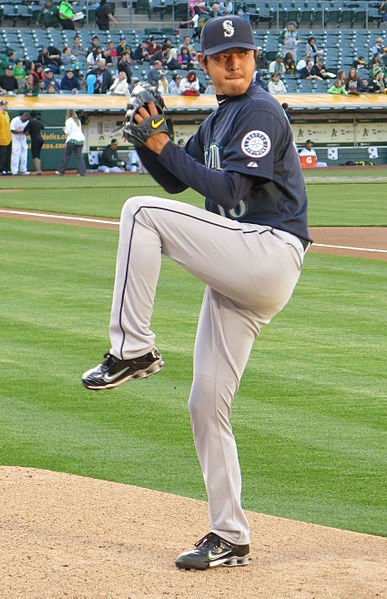
Hisashi Iwakuma (LiAnna Davis, wikimedia commons)
The Mariners re-signed Hisashi Iwakuma last Friday in a surprise turn of events. I had counted on the Mariners making a smattering of minor moves that I could post about at my leisure over break, but Jerry Dipoto's wheelings and dealing know no bounds.

Also, to simply say Iwakuma was retained understates the drama that played out. Iwakuma had an agreement with the Dodgers but they wanted to renegotiate based on some things that popped up in a physical they administered. It is rare for deals to fall through because of a physical, and even more rare to watch one disintegrate and have another team so swiftly jump in and take advantage. It appears that 'Kuma's deal with the Mariners took less than 24 hours to come together.

Physicals and medical records are hardly a reasonable blog topic. I am far from a trained medical professional, and there is the whole medical privacy thing that means I have not seen anything of Iwakuma's anyway. Still, it is hard to imagine whatever the Dodgers found to be all that concerning. Iwakuma turns 35 years old early in the 2016 season. The odds of some wear and tear on 'Kuma's arm are extremely high, and it is not as if his arm needs to hold up for another decade. It needed to last three seasons, if the reported deal with Dodgers was accurate. What was so dangerous that the Dodgers, the team spending more money than any other in baseball, worried about their investment?

Also, it seems reasonable that Iwakuma wanted to stay in Seattle. Why would he backpedal out of the Dodgers deal so quickly and sign an incentive-laden deal with the Mariners? He did not even shop around as was his right as a free agent. All I am saying is that I am not convinced whatever concerns popped up in Iwakuma's physical were at the heart of his deal with LA falling apart. The Dodgers might have simply been doing their due diligence and accidentally triggered some soul-searching for Iwakuma.

Bottom line, Hisashi Iwakuma is back with the Mariners, and seems legitimately excited to return. His dabbling with the Dodgers turned out to be a blessing in disguise too.

Jerry Dipoto said that the Mariners had to extend their budget to re-sign Iwakuma, though he also mentioned that it took "less than five minutes" to get authorization. It is clear that ownership thinks highly of Iwakuma, as they should. Still, the reason that the Mariners did not have budget room was because Dipoto had moved on from Iwakuma. In particular, the addition of Wade Miley cost money.

The Mariners baked their cake and ate it too by happenstance. They nabbed a replacement for Hisashi Iwakuma and then got Iwakuma back anyway. This would not have happened if they had signed Iwakuma in the first place, because then there would not have been an authorization to add payroll. Ultimately, this is the real blessing of how the Iwakuma situation played out.

Dipoto and the Mariners already had a solid offseason before signing Iwakuma. Now they have had a very good offseason, if not a great one. The metamorphosis of the 40-man roster is largely done, which is not to say that moves are over and done with, but the overall shape and feel is in place with capable players in each spot.

The 2016 Mariners have the look of a contender, especially with Iwakuma back in the fold. Jerry Dipoto stuffed many stockings with all his moves, and thankfully he doled out very little coal.

Dipoto's Deals Know No End

You know what might be a fun game right now? Trying to guess who is on the Mariners roster right now. The names change daily. I like to keep transactions separate in unique posts, but Dipoto's frantic remodeling has made me reconsider. Plus, this week's moves seem more like a larger suite of deals that all go together. The recap:

DEPARTURES

  • 1B/"OF" Mark Trumbo and LHP C.J. Riefenhauser traded to the Orioles for C/1B/3B Steve Clevenger - Trumbo was likely to earn around $9 million with a skillset that is essentially the antithesis of what we've come to expect from Dipoto. Trumbo is a very limited defender with minimal on-base skills. Riefenhauser was acquired earlier this offseason from the Rays, which means Dipoto has now traded someone he traded for! That seemed inevitable with his wheeling and dealing. In return, the Mariners got a replacement-level catcher who may or may not allow the M's to give Mike Zunino some development time in AAA. I suppose he adds some defensive versatility too. The Mariners gave up more talent than the Orioles in this trade, but also shed Trumbo's salary and opened up a roster spot to sign someone more in Dipoto's mold.
  • OF/3B Patrick Kivlehan traded to the Rangers as the player to be named later in the Leonys Martin deal - Kivlehan is significant by player-to-be-named-later standards, and he has a chance to carve out an MLB career. It stings a bit to see him leave. However, he helped the Mariners get the center fielder they needed, and his loss opens up another 40-man roster spot.
  • RHP Jose Ramirez traded to the Braves for a player to be named later or cash considerations - Ramirez has control problems but a big arm with some home run troubles. He is not all that far off from the Dipoto mold for pitchers, and Dipoto wants to build up pitching depth. However, he decided that whatever talent Ramirez possesses on the mound did not outweigh the added roster opening at this stage in the offseason. The move reduced the M's from a full 40-man roster to 39. I think it is safe to assume that Ramirez was going to get cut loose at some point in the near future when the Mariners acquire yet another player, and Dipoto found a team who wanted Ramirez bad enough to give the Mariners something.
ARRIVALS
  • 1B Andy Wilkins, via waiver claim - I don't have much to say about this one. He looks like AAA depth, though Dipoto took the time to claim him on waivers and use a 40-man roster spot on him. This probably says more about his (lack of) faith in Jesus Montero than anything else.
  • OF Nori Aoki, via free agency - I wrote about this move yesterday.
  • RHP Justin De Fratus, via free agency - De Fratus fits the mold for Dipoto bullpen arms. Some success in the past, but not last year, despite underlying peripheral stats that suggest no real change in overall skill.
  • Steve Clevenger, as already mentioned above in the Trumbo trade.
I think it is easier to think of all these separate deals as one big deal because then some clearer trade-offs emerge.

Mark Trumbo was probably a first baseman with the re-worked Mariners roster. He is gone and Wilkins takes his place on the depth chart. Wilkins is not as good as Trumbo, but he also costs $8+ million less. Trumbo was about to become an overpriced starter that produced some value, but not an incredible amount.

Nori Aoki takes Patrick Kivlehan's spot on the roster. This is a clear upgrade for 2016. His salary is also negligible because he costs about as much as Trumbo did in 2015. A trade of Trumbo and Kivlehan for Aoki and Wilkins makes quite a bit of sense for the Mariners. It makes them a better team in 2016 and could only look bad in the years to come if Kivlehan develops into an everyday player in Texas.

Jose Ramirez and Justin De Fratus essentially trade places too. This is another upgrade for the Mariners. De Fratus struggled last year, but he was still better than Ramirez and also comes with a track record of modest success in the majors.

That leaves C.J. Riefenhauser and Steve Clevenger as the final pair in this overall deal. This one is more abstract to figure out since they do not play the same positions. The overall value might be equal here. Clevenger plays the more demanding position (catcher) and has a little more success in the majors to his name, but he is also out of minor league options. Additionally, Riefenhauser is left-handed, which should account for something. However, Clevenger's presence allows the Mariners to much more comfortably make the right decision with Mike Zunino's development. If Zunino can develop into the star that many think he can be as a result of this little depth-bolstering move, then this is a huge gain for the Mariners.

So, overall, the only downgrade the Mariners made this week was at first base, but in the process they got better in several other areas. Moreover, the value they lost at first base should be relatively easy to replace at some point in the offseason. Dipoto might solve first base tomorrow at the rate he is going. The M's 40-man roster stands at 39 players so he might already have someone lined up for all we know.

Still, even before Jerry Dipoto find the M's starting first basement for 2016, the moves this week make sense when considered together. He is doing the equivalent of roster gerrymandering - trying to reallocate skill levels in different levels and different places which will make wins pile up better.

Dipoto Grabs More D, Acquires Sardinas

Jerry Dipoto, it turns out, is a man of his word. He said he wanted to make the Mariners more athletic and focus on run prevention. Both of his outfield acquisitions, Boog Powell and Leonys Martin, fit that mold. However, the Mariners were starved for outfielders. Dipoto's most recent trade really begins to show his value in defense.

Yesterday the Mariners made a minor move, shipping OF Ramon Flores to the Brewers for INF Luis Sardinas. I would argue this trade is the most interesting of Dipoto's so far because it gives us the best look at his vision. It's the first deal he made that did not address a gaping hole on the roster, so presumably this says something about how he values Sardinas and his skills.

Let's start with Flores though. We hardly got to know him. He was part of the package the Mariners got in return from the Yankees for Dustin Ackley at the trade deadline. Flores got off to a torrid start in Tacoma but broke his leg and missed the remainder of the season.*

*I was at the game where Flores broke his leg. It was weird. No contact involved. He crumpled to the ground in the middle of running down a ball in the right-center field gap.

I felt that Flores had a fringy toolset, but in areas where the Mariners lacked any skills. He batted leadoff in Tacoma and I quickly fell in love with his approach at the plate. Flores worked counts and was a safe bet to put the ball in play, often enough in the form of a pretty solid line drive. I liked him as a darkhorse to make the Mairners opening day roster, assuming he had recovered from his broken leg.

Luis Sardinas is an interesting return for a player like Flores. Sardinas is not much of a hitter (at least yet) but he can play shortstop and already has experience at second and third base. At worst he is a utilitiy infielder. However, Sardinas is only 22 years old and has a few cups of coffee in the majors to his credit already. He was also listed among the top 100 prospects in all of baseball in 2013 and 2014 by Baseball America. For a little perspective, neither Brad Miller nor Chris Taylor had gone beyond AA by the time they were 22 years old, and neither were ever listed as a top 100 prospect. This is hardly a guarantee that Sardinas will be an impact player in the majors, but he brings some interesting upside to the Mariners while also adding defensive depth around the infield.

I doubt anyone, Jerry Dipoto included, thinks that Luis Sadinas is a better hitter than Ramon Flores. So, Dipoto is banking on Sardinas providing value defensively, especially at shortstop. However, the Mariners already have Ketel Marte and Chris Taylor on the roster, so Sardinas is a bit buried on the depth chart. He is almost certainly more buried than Ramon Flores was.

Perhaps the Sardinas deal is actually a harbinger of yet another trade, ala when Dipoto acquired Joaquin Benoit and then shipped away Tom Wilhelmsen. However, this deal can also stand on its own. Sardinas is younger with better reports on his defense. He fits the Dipoto of team control and run prevention. He appears to show just how serious Dipoto is about both, given that Sardinas does not play a position of need like other Dipoto acquisitions have.

Ultimately, Sardinas reminds me some of Joaquian Arias, who is the definition of a replacement-level infielder. So, this trade is not likely to make a huge impact. However, from a skillset perspective, it says something about how devoted Jerry Dipoto is to defense and run prevention.

Robertson Claimed, Piles Grow

The Mariners made a small move yesterday, claiming OF Daniel Robertson off of waivers. He is the second waiver pick-up by Jerry Dipoto so far. The other is RHP Cody Martin, which happened so far underneath the radar that I did not notice until yesterday. The move actually happened October 19.

Neither Robertson nor Martin are exceptional on their own, but they both provide more clues on Dipoto's vision.

It is easy to see why Robertson was available on waivers. He is 30 years old and listed at 5'8". Unsurprisingly, Robertson has never hit for power, and really has not hit at all in the majors. However, Robertson is a capable defender at all three outfield positions and has a strong history of plate discipline throughout his time in the minor leagues. Jerry Dipoto has stated publicly that he wants athletic outfielders and prefers a style of baseball with lots of baserunners moving from station to station. Robertson is hardly an impact bat, but his limited skills are the ones that the Mariners did not have under Jack Zduriencik.

Cody Martin made his MLB debut last year and was about as unfortunate as unfortunate gets. He got lit up to the tune of a 7.92 ERA out of the bullpen. That was caused, predictably, by a high home run rate (21.1% of fly balls, over double the league average). Martin also suffered from a very low strand rate, meaning his baserunners came around to score well more than average. Martin has a track record of solid success starting in the minor leagues though, and Jerry Dipoto is clearly banking on both regression to the mean and Safeco's friendly confines masking the dinger issue. Plus, the Mariners needed some pitching depth. Martin is exactly the kind of pitcher that Dipoto should be going after to fill in roster depth.

Obviously, the offseason has barely begun and Jerry Dipoto likely has many more moves left before the Mariners report to Peoria next spring. However, even with the few moves on the books, it is clear that Dipoto is focused on finding strikeout pitchers with lots of team control (even if they have elevated home run rates), and speedy outfielders with on-base and defensive skills. So why not take a peek at what the Mariners opening day roster might look like right now? Here is my best guess:

STARTING LINEUP
  1. Boog Powell (CF)
  2. Ketel Marte (SS)
  3. Robinson Cano (2B)
  4. Nelson Cruz (DH)
  5. Kyle Seager (3B)
  6. Mark Trumbo (1B)
  7. Seth Smith (RF)
  8. Franklin Gutierrez (LF)
  9. Mike Zunino (C)
BENCH
  • Chris Taylor (INF)
  • Shawn O'Malley (UT)
  • Daniel Robertson (OF)
  • Jesus Sucre (C)
STARTING ROTATION
  1. Felix Hernandez
  2. Taijuan Walker
  3. Nate Karns
  4. James Paxton
  5. Roenis Elias
BULLPEN
  • Cody Martin
  • Tony Zych
  • C.J. Reifenhauser
  • Vidal Nuno
  • Tom Wilhelmsen
  • Charlie Furbush
  • Carson Smith
This is just my best guess, and actually I would guess that neither Dipoto nor Scott Servais has conducted this thought experiment with how crazy early it is in the offseason. I assumed all Mariners free agents were gone (hence no Iwakuma) and also assumed no free agent signings.

The 2016 Mariners will obviously look different, and in all likelihood better, than this current projected roster. That's not really the point of the exercise though. The point is that it is pretty easy to see the overall structure of the roster already. The outfield looks different, and the skillset Dipoto is focused on out there is likely to make the top and bottom of the lineup look very different. The pitching staff already looks like it will generate lots of swings and misses, but also more than fair share of fly balls. This makes a good defensive outfield all the more important.

I hope that Dipoto builds up some more depth, and there is little doubt he will do that. I like the overall feel of the Mariners team he is building. The little moves so far are building up some piles of serviceable players in spots where the Mariners had no replacement level players. It seems like the players being brought in are puzzle pieces that contribute to a better whole. This is progress.

Crazy Legs for Boog (and Others): Offseason Begins Unexpectedly

Brad Miller
(Flickr via Wikimedia Commons, Keith Allison)
Jerry Dipoto consummated his first deal as Mariners GM, a six-player swap with the Rays. It also doubles as the first transaction of the offseason made by any team. The trade is (probably) not star-studded, but nonetheless and interesting six-player deal that raised some eyebrows. The blow-by-blow recap:

Rays acquire:

  • RHP Danny Farquhar - Lord Farquhar was a revelation in 2014, and really near the end of 2013 too. He combined a 96-mph heater with a very good cutter and racked up strikeouts at a prolific rate. However, Farquhar struggled mightily last season and shuttled between Seattle and Tacoma a bit. Farquhar could regress next year, which for him means improving to his 2014 form, but his inclusion in this deal suggests that Dipoto saw him as fringy depth.
  • SS? Brad Miller - Crazy legs is clearly the key piece in this deal, and in all likelihood the best player of all six traded. However, Miller's value is hard to judge, and his trade value is especially mysterious. Miller is a polarizing player because of his skillset. He has gap power, nice speed, and just enough contact and plate discipline to be a respectable hitter. This is a tremendous combination for a shortstop, but opinions of Miller's defense at shortstop vary wildly. Some think he is awful and must move off the position immediately. Others point to data like UZR and suggest that he his at least league average. An average defender at short with a league-average bat is a borderline all-star. An average defender in left field with an average bat is a fringe starter. So, a team who sees Miller as a shortstop would value him much more than a team who thinks he must move off the position. Any team acquiring Crazy Legs likely sees him as a shortstop, but also likely knows that he should come at a bit of a reduced price because other teams would have no interest in him. I always liked Miller as a shortstop so his inclusion in this trade his hard for me to stomach. More on this in the analysis to follow.
  • 1B Logan Morrison - Frankly, I view LoMo as less than a throw-in. He penciled in as a bench bat slated to make around $4 million in arbitration. There was little doubt in my mind that Dipoto would get rid of him one way or another. The Mariners collected way too many 1B/DH types under Jack Zduriencik. The $4 million man most likely to sit on the bench many days was a very logical guy to go.
Mariners acquire:
  • RHP Nate Karns - Karns fits the Dipoto mold. He is a hard-throwing righty that racks up strikeouts, along with a disproportionate amount of home runs. Whether his high home run rate is an unsustainable fluke or an underlying flaw in his game remains to be seen. Either way, Safeco Field is likely to mask this problem. At worst, Karns is a serviceable starting pitcher under cheap team control for several years. At best, he could take a step forward and be a legitimate mid-rotation starter.
  • CF Boog Powell - Powell also fits the Dipoto mold, or at least the vision he shared of his kind of Safeco Field team. Powell has little power to speak of, but has exhibited great patience, plate discipline, and contact ability throughout the minors. Moreover, scouting reports suggest that Powell can serviceably defend all three outfield positions. Powell's skillset screams marginal MLB talent, but his specific things he is good at are things that were virtually non-existent on the Mariners roster.
  • LHP C.J. Riefenhauser - A lefty reliever yet to do much in the majors (albeit in limited opportunities), Riefenhauser has been productive in the minors and has lots of years of team control remaining. The lengthy team control is probably his greatest asset, though he is also highly likely to log some time in the M's bullpen in 2016.
It is easy to look at this trade and be disappointed in Dipoto and the Mariners. Farquhar, Miller, and Morrison all logged significant time with the Mariners the last two years. Only Karns has done much of anything in the majors among the trio the Mariners receieved. Also, Farquhar, Miller, and Morrison were among the Mariners more interesting, charismatic players. Brad Miller with his crazy legs and gorgeous stirrups, Farquhar with his brutal honesty in interviews (like saying he was sent down because he sucked), and LoMo with things like running to the mound and asking Fernando Rodney where his arrow went. I simply enjoyed the presence of the players the M's got rid of in this trade, and the players received are, at least at the moment, so anonymous.

I am glad I waited a day to write this post though. The deal has grown on me considerably in the past 24 hours. It is a tad risky, but makes good sense, especially when some hidden assets in the deal are considered.

The Mariners needed some team-controlled, cost-controlled depth. Robinson Cano, King Felix, and Kyle Seager are all signed for $100+ million for the next several years. Nelson Cruz is not exactly cheap either and has three years remaining on his deal. The Mariners have to count on these players being the core of their team. However, the Mariners won't win with this core if they cannot assemble decent talent around them, and that talent will have to come on a budget. These players do not need to be stars, but they need to be complimentary pieces at reasonable prices - in other words, decent players who are years short of hitting free agency.

Boog Powell has 6 years of team control remaining. His MLB clock hasn't started. Riefenhauser has at least 5 years of team control. Karns has at least 4. LoMo had 1 year of team control left, Farquhar and Miller were at 3 or 4 apiece. The Mariners added several years of cheap, team-controlled talent in this trade, which cannot be ignored in the overall valuation of this deal. In fact, the gap in team-controlled years involved in this trade is large enough to expect the Mariners needed to give up more talent to offset this gain - and pursuing decent players with lots of team-controlled years, given the current structure of the Mariners payroll, is somewhere between wise and necessary.

So, Danny Farquhar is probably a more talented reliever than C.J. Riefenhauser. However, I would argue he is a less valuable overall asset. Riefenhauser is left-handed with a couple more years of team control. If both Farquhar and Riefenhauser project as bullpen depth - either in middle relief in the majors or as one of the first call-ups from Tacoama - taking the guy with more cheap, team-controlled years is a no-brainer. The talent gap doesn't matter as much as the millions of dollars that can be spent somewhere else.

Similarly, this is why Logan Morrison could almost be considered a liability for the Mariners. He projected to have marginal playing time at best*, with only one year of team control remaining, and a relatively pricey year given his projected role. LoMo's lumbering lefty power would have been nice to have stashed away on the bench, but LoMo as an overall asset did not make much sense for the 2016 Mariners. The price point and lack of team control are not good fits at all.

*Assuming Mark Trumbo plays first base, which seems especially safe with this trade.

Ultimately, this all suggests that the talent gap between Brad Miller and the combination of Nate Karns and Boog Powell has to be substantial before this deal turns out bad for the Mariners. There is room for Miller to blossom for the Rays and for the Mariners to still be better for making this trade. 

The deal is even less likely to turn out bad given the complexion of the Mariners roster. They desperately needed capable defensive outfielders and some plate discipline, the two things Zduriencik completely ignored the last few years as he horded ALL THE DINGERS FOREVER. Boog Powell has plate discipline and outfield defense. It remains to be seen if Powell's skills are strong enough to carve out a legitimate spot in the majors, but he at least possesses skills the Mariners sorely lacked. 

As for Karns, he will help eliminate the need to stretch out relievers to start, which is what the Mariners ended up doing after the All-Star break (Vidal Nuno, Edgar Olmos, and even Tony Zych for one start). Rotation depth was absolutely necessary, especially with Hisashi Iwakuma as an impending free agent.

At worst, the Mariners got a little depth with lots of cheap, team-controlled years. At best, they got themselves a nice mid-rotation starter and an everyday centerfielder who could also be an effective leadoff hitter. Dipoto's comments suggest that he believes he got the latter, not the former, which makes it easy to see why he would part with Brad Miller. I think Dipoto is looking through this trade with rose-tinted glasses based on his comments, but even an outcome noticeably short of Dipoto's vision is still one worth making.

Dipoto's Delightfully Insane Front Office

Jerry Dipoto more or less locked in his whole front office this week (manager included!) A few weeks back I had a list of people who did not know their fates. Those fates are now known. Let's start there:

The remaining unknowns:
  • Tom Allison (pro scouting director) - staying with the Mariners in the same position
  • Roger Hansen (assistant to the GM) - staying with the Mariners in the same position
  • Jeff Kingston (assistant GM) - staying with the Mariners in the same position
  • Tim Kissner (international scouting director) - staying with the Mariners in the same position
  • Tom McNamara (amateur scouting director) - staying with the Mariners in the same position
I find this non-news rather remarkable news in itself. Dipoto did not come in and blow up the leadership. Only Hansen pre-dates Jack Zduriencik, so it isn't like any of these people are lifers within the Mariners franchise. They were Zduriencik hires and now they remain. This will not get enough attention because the lazy narrative has already been written: New GM comes in, fires manager, cleans house. Dipoto let Lloyd McClendon go over differences in approach, which seemed like a convenient euphemism for "I'm not dealing with another Mike Scioscia situation."

However, given how many people Dipoto kept on from the Zduriencik regime, it sure seems like Dipoto legitimately talked with McClendon and took time to discern whether he and McClendon could work together. Dipoto clearly gave everyone in the front office some time and thought, and ended up deciding their vision fits with his.

However, Jerry Dipoto made one splash, and it looks significant. He hired Andy McKay as the new farm director. McKay replaces Chris Gwynn, who resigned - though, now that we can see the whole picture a bit more clearly, he was likely either going to choose to leave or be told to leave.

Nobody knows how McKay will do as farm director, McKay included. He was the "peak performance coordinator" in Colorado when Dipoto reached out to him about the M's opening. He was a mental coach of sorts.

Dipoto and McKay did not know each other before McKay's interview with the Mariners, though Dipoto knew of McKay. Apparently Dipoto reached out about a position with the Angels a few years back, but one way or another an interview never happened.

McKay seems to have some strong opinions on how teams develop players, especially mentally. He went as far as saying no team does a good job developing the mental side of the game. McKay added that he has developed a program for mental training. Seems pretty obvious that the 2016 Mariners will be his first real guinea pigs.

I knew nothing about Andy McKay until roughly Wednesday of this week, but I am convinced this is a huge hire. The idea of Andy McKay is what's so powerful. None of us know how this move will work out, but I love the theory and there is only one way to find out if the theory actually works - put it into practice and see what happens.

Sports psychology has been a big topic rumbling around the back of my head for a few years, probably thanks to where my research as a high school teacher has led me. I say with some confidence that I think about student metacognition on math problems more than 99% of baseball bloggers, but every now and then those thoughts drift perilously close to baseball.

For instance, one of the most powerful ideas I've ever read about is Carol Dweck's research on mindsets.* Her research suggests that human beings approach contexts with either fixed or growth mindsets. The basic notion is that people with fixed mindsets believe they are permanently only so good or so bad at something. Meanwhile, people with growth mindsets believe that their abilities change over time depending on what they do and experience.

*I also say with some confidence that I am among, I don't know, 1-5% of baseball bloggers who could quote research from Carol Dweck in a baseball post? I know you've all been waiting for some educational research to show up on the Musings! #Shocktober

Theoretically, two people with identical pre-requisite skills and knowledge could approach a situation with different mindsets. What Dweck's research has shown is that these two theoretical people, over time, will end up in different places. The person with a growth mindset is more likely to grapple with challenges, persist, and ultimately get better. A person with a fixed mindset is more likely to feel threatened by a challenge and avoid it, which results in a skill plateauing or possibly even fading.

It's not that mindset is everything, but it is clearly something. Moreover, there are ways to frame communication and rephrase feedback which promotes growth mindsets over fixed mindsets. Mindsets can be cultivated, or in sports terms, be coached. There are moves I make which research suggests push my students towards growth mindset in math. Sometimes I've paused and wondered if similar moves could be used in a minor league system. It seems like something that would generalize quickly and easily.

I don't know what McKay's program entails, but I thought about things like mindset. They matter, they have been shown through scientific research to make a difference, and sports have been more blind to them than just about anything else that could impact performance. This is why sports psychology has struck me as a field for potentially massive growth, and I've wondered who would be the first team to make an aggressive push into the field.

Answer: the Seattle Mariners. Shocktober!

Of course, there is a reasonable chance many (or all) teams are doing something with sports psychology. However, nobody with McKay's background has held such a significant leadership position, with the power and responsibility that such a position entails.

McKay is a bold hire, and if he works out like Dipoto hopes, the Mariners will enjoy a significant advantage over everyone else for a few years before other teams catch on. If he doesn't work out - oh well. The Mariners player development has been a disaster for several years now. It is the most logical explanation for why the team cannot develop MLB talent despite high draft picks that are consistently praised as good picks across baseball. The draft is a crapshoot, but it's not nearly as bad of a crapshoot as the M's player development track record suggests.

It is also interesting to see how surgical and open-minded Jerry Dipoto is. He kept Zduriencik's leadership in tact except for two key places, farm director and manager. Adam McKay brings a revolutionary approach to player development, and new manager Scott Servais comes from a background in player development. It's very obvious now that Jerry Dipoto believes the main (if not only) problem with the Mariners under Jack Zduriencik was player development.

Dipoto now has a manager who has never managed and a farm director who has never directed anything in a front office that he had never met until a week or two ago. These are the men charged with fixing the Mariners, especially given that nobody else changed. How could this possibly go wrong?

The plan has a self-evident disaster factor, but the Mariners player development was already a disaster. There is nothing to lose. This is an obvious situation worth taking a wild risk in with hopes of a massive reward. I kind of like this Dipoto guy.

Servais at Mariners Service

The Mariners have themselves a new manager. Scott Servais will take over the reigns. Tim Bogar will also reportedly be his bench coach. The hires are mildly surprising, but about as mild as mild gets.

I wrote my major Dipoto post two and a half weeks ago and predicted that we would see an infusion of Angels front office personnel. Both Servais and Bogar were in the Angels front office with Dipoto. They were obvious candidates to follow Dipoto up to Seattle. However, among the two men, Bogar has managing experience and Servais does not. Moreover, Bogar's managing experience includes lots of winning (albeit in the minor leagues).

So, it would seem more logical to hire Bogar as manager and Servais in another position. The men hired make total sense, but the positions are a bit surprising. However, Dipoto is considered more "new school," which means the manager executes the general manager's vision to a large degree. This is a paradigm shift for the Mariners as a franchise. Servais does not have the same leadership role within the Mariners as Lloyd McClendon did, or if you prefer to harken back to the good old days, certainly different from Lou Piniella.

The early takes on Servais's hiring are focused on his lack of managerial experience and how that is a trend in baseball at the moment. I don't think that is the most interesting angle in this story. Really, Servais provides us another glimpse into Dipoto's vision.

Scott Servais carved out a respectable 11-year career in the big leagues, which should immediately buy him credibility in the clubhouse despite his lack of managerial experience. Moreover, Servais's post-career experience all came in front office roles, and more specifically in LA of A he was involved in player development. So, this hire strongly suggests to me that Dipoto is placing a premium on developing the Mariners core that has already reached the major leagues - so much so that he was willing to hire a man without managing experience.

This is where Tim Bogar comes in. The bench coach is the manager's right hand man. He is the guy the manager always checks in with about moves, tactics, and strategy. Bogar's minor league managing experience will be valuable in this role, plus Dipoto knows he can work with Bogar and trusts that Bogar's tactics will not deviate from the overall vision Dipoto has for the Mariners.

The Mariners finished hiring the major leaders within their front office over the week but I have not had time to write about those hires yet. That post will come out tomorrow. The restructuring already suggested that Jerry Dipoto more or less liked everything the Mariners were doing, except in player development - but he really, really disapproved of what the Mariners were doing in player development from the looks of it. More on this later. All I am saying right now is that Dipoto is clearly focused on fixing the M's player development track, and hiring Servais as the manager fits within that focus.

Lloyd Let Go

Lloyd McClendon (wikimedia commons, EricEnfermero)
Yesterday the Mariners announced that Lloyd McClendon would not return as Mariners manager in 2016. This is not too surprising, given that the M's hired a new general manager. For what it's worth, Jerry Dipoto had several conversations/interviews with McClendon the last few weeks before making this choice. Still, given that Dipoto never had a chance to hire his own guy with the Angels, and he had significant disagreements with his manager, this is not a stunning result.

Lloyd McClendon was not a problem. Far from it. In fact, he is only the second Mariners manager to end his tenure in Seattle with a winning record. The other? Lou Piniella, of course. It is another datum point that points to the strangeness that was the Zduriencik era. Lloyd McClendon stands among the better managers in M's history. Zduriencik kept the M's GM post longer than anyone else. Ultimately their tenure will clearly be remembered as unsuccessful, but on some level they did better than everyone except the leadership during the M's golden years around the turn of the millenium. So, is it ultimately fair to call McClendon and Zduriencik failures? Some food for thought.

Anyway, it is more interesting to look forward at the moment and wonder what will happen. There are already rumored candidates for the Mariners manager position and the lists look both logical and realistic to me.

There will be plenty of time to talk about the manager though. That is a high enough profile position to receive media attention. Jerry Dipoto has done much more than make a decision on Lloyd McClendon. In fact, McClendon was the last of several dominoes that fell this week. Here is a recap:

LEAVING
  • Rich Donnelly (third base coach)
  • Chris Gwynn (farm director)
  • Trent Jewett (bench coach)
  • Lloyd McClendon (manager)
  • Joe McIlvaine (assistant to the GM)
  • Joe Nigro (MLB scout)
  • Mike Rojas (bullpen coach)
  • Duane Shaffer (MLB scout)
  • Ted Simmons (assistant to the GM)
  • Andy Van Slyke (outfield coach)
  • Pete Vuckovich (assistant to the GM)
CAN STAY IN NEW POSITION
  • Chris Prieto (was MLB coach)
  • Rick Waits (was pitching coach)
CAN STAY IN CURRENT POSITION
  • Edgar Martinez (hitting coach)
  • Chris Woodward (infield coach)
UNKNOWN STATUS OF SOME KEY MEMBERS
  • Tom Allison (pro scouting director)
  • Roger Hansen (assistant to the GM)
  • Jeff Kingston (assistant GM)
  • Tim Kissner (international scouting director)
  • Tom McNamara (amateur scouting director)

It is hard to say too much about all the moves at this point. Frankly, it would have been unsurprising if Dipoto let everyone go, with the possible exception of 'Gar. His standing within the franchise is too high-profile and I would imagine there was significant pressure to keep him.

If any move is interesting among these, I would say it is keeping Chris Woodward. That may signal something about Dipoto and what he is about. The next Mariners manager may not be able to hire his own infield coach, assuming Woodward wants to stay. I find it interesting, and maybe even surprising, that a GM has a clear enough vision of what he wants that he can find the right infield coach without knowing who the manager is. This suggests to me that the manager will work very closely with Dipoto, and to a noticeable degree be expected to carry out Dipoto's wishes and vision. This sort of relationship is certainly more "new age," with the team's leadership revolving around the general manager instead of the manager.

In general, I anticipate a mass migration from the Angels front office (specifically their baseball operations division) up north to Seattle. Dipoto was in LA of A long enough to hire many of "his people" in leadership positions, and given that he lost the power struggle there, and new Angels GM Billy Epler likely wants to hire many of his own connections, it seems that many of people Dipoto works with best are about to be free agents. MLB contracts typically run through October 31, plus MLB prefers teams do not make news during the playoffs, so it is doubtful that the Mariners will announce many (or any) new hires soon. However, it would be worth paying attention to Eppler and the Angels as they figure out who will stay and go. Anyone cut loose should immediately become a strong candidate to join the Mariners in some leadership role.

However, with that said, the Mariners front office under Zduriencik had more positions than Dipoto's heirarchy in LA of A. So, he might not replace some of the people let go. We will get more of the Dipoto's vision over the next few weeks as we get news of Mariners hires.

Jerry Dipoto

The Mariners hired Jerry Dipoto a week ago to take over the good ship Mariner for the foreseeable future. I wish I would have written about him sooner, I guess. This post would feel a bit timelier if this news was more new, but such is life. Also, in the meantime I have taken some time to do research. Plus, honestly, Dipoto was not going to do anything in the last week of the season. His job starts today.

First of all, if you are thirsting for a hot take, I like the hire. I might even love the hire. Kevin Mather said he wanted a GM with experience that would not waste what remains of the Felix-Cano-Cruz prime. That makes good sense, though the task seemed awfully tall.

I saw only two experienced GMs that would be available and worth hiring: Dave Dombrowski, who the Red Sox swooped in and hired in a rather stunning move, and Jerry Dipoto. Maybe Ben Cherington too, once Dombrowski was hired by the Red Sox, but I prefer Dipoto to Cherington. While Ben has one World Series championship to his credit, and what appears to be a strong Boston farm system, the up-and-down massive roster fluctuations that he orchestrated in Boston seem unhealthy to me. He does not look to me like the kind of GM that would succeed in Seattle without blowing up the roster. Mather made it clear the roster wasn't going to be blown up, so at the very least Dipoto is the better fit.

Dipoto's background is intriguing, especially given his reputation as an analytics guy. He issued an ultimatum to Angels owner Arte Moreno because Mike Scioscia would not adopt some of Dipoto's data-driven suggestions. Dipoto resigned over the struggles, so he has some conviction in his beliefs.

What is unclear to me is exactly where and why Jerry Dipoto became an analytics guy. He broke into the majors as a relief pitcher in 1993 and carved out a modest MLB career that ended in 2000. He was with the Rockies at the time and immediately transitioned into their front office as a scout. Dipoto silently went about his business as a scout with the Rockies from 2001-2002, and then he scouted for the Red Sox in 2003 and 2004. He probably picked up his analytics bend in Boston, given that he scouted for them at the height of the Theo Epstein era. 2004 is when the Red Sox broke their long-standing curse. However, that's just a guess on my part.

Dipoto returned to Colorado as their director of player personnel in 2005 and then jumped to the Arizona Diamondbacks, where he held leadership roles in their player personnel/player development department from 2006 through 2011. He gained a reputation as GM material during his time in Arizona, probably thanks in part to how their farm system performed while he held a key leadership role. Here are some notable Diamondbacks draft picks while Jerry Dipoto worked for them in player development:

  • 2006: RHP Max Scherzer, LHP Brett Anderson, LHP Clay Zavada
  • 2007: RHP Jarrod Parker, RHP Josh Collmenter, RHP Evan Scribner, OF Golden Tate*
  • 2008: LHP Daniel Schlereth, LHP Wade Miley, RHP Bryan Shaw, OF Collin Cowgill, LHP Danny Hultzen (!)**
  • 2009: CF AJ Pollock, 3B Matt Davidson, SS Chris Owings, 1B Paul Goldschmidt, RHP Chase Anderson
  • 2010: CF Adam Eaton
  • 2011: RHP Trevor Bauer, RHP Jed Bradley, LHP Andrew Chafin

* Yes, the same Golden Tate that currently catches passes for the Lions. Fun fact!
**Hultzen didn't sign with the Diamondbacks, hence why he became a high M's draft pick later

That is quality and quantity by MLB draft standards. It intrigued the Angels enough to name Dipoto their GM after the 2011 season ended.

I will not say as much about the Dipoto Era in LA of A as this Halos Heaven recap (very much worth reading), but I will summarize the Halos Heaven work. Long story short, there was a power struggle between Dipoto and Scioscia from day one. This was further complicated by the blockbuster signings of Albert Pujols and Josh Hamilton, both of which were largely negotiated by Angels owner Arte Moreno no matter the wishes of Dipoto or Scioscia.

Dipoto had some power in LA of A, but only so much. His payroll got engulfed by massive contracts he had no say in, so his trades had to focus on supporting pieces with an eye towards cost control. Supporting pieces, basically by definition, have strengths and deficiencies as players. If they had no blemishes then they would be stars. Dipoto had to find these players that he valued within a world where his manager had different values. The tension eventually boiled over and Dipoto left.

So, this is my long way of saying a few things. First of all, I am not convinced that Jerry Dipoto is an analytics guy. He certainly does not have the usual analytics background. For instance, Astros general manager Jeff Luhnow worked for McKinsey and Company (a business consulting firm) and was COO of Archetype Solutions (his own consulting firm) before stepping foot in a baseball front office. Theo Epstein has an undergraduate degree from Yale and a juris doctorate (JD) from the University of San Diego that he earned while he was an intern with the Padres. These are the kinds of backgrounds that analytics guys tend to have. Dipoto's background is classic old-school: the former player who continues his life in baseball by going into the front office.

Moreover, Dipoto rose to front office leadership roles in places not exactly noted for their love of analytics. The Diamondbacks could have offered their vacant GM position to Dipoto in 2011 (he served as interim GM to finish out the 2010 season) but instead opted for Kevin Towers. He famously traded Justin Upton in 2013 and publicly stated that Upton wasn't "gritty" enough for the D'Backs. Towers also ditched Trevor Bauer in a curious deal that clearly boiled down to personality differences much more than performance.

Then there was the lengthy struggle with Mike Scioscia that has already been referenced a few times in this post. Reports surfaced that Dipoto could not get Scioscia to use scouting reports. This is pretty easy to believe based off of anecdotal evidence.

I have no doubt that Jerry Dipoto was at the forefront of analytics in his contexts. However, his most significant experience is with organizations that are noteworthy for their obvious disregard of analytics. I will believe the advanced analytics when I see evidence of them, which should pop up in Seattle if they exist in Dipoto's ethos.

So what is Jerry Dipoto going to do with the Mariners?

I think one of the most interesting questions is what Dipoto will do with Lloyd McClendon. Popular thinking suggests that he butted heads with old-school Mike Scioscia, so a similarly old-school manager like McClendon is obviously toast. I don't think the answer is that straightforward. Again, Dipoto's background suggests more than a splash of "old-school" pumping through his veins. Also, McClendon isn't a godfather-like figure in Seattle like Mike Scioscia was (and remains) in LA of A. The power dynamic in Seattle is very different, and that cannot be overlooked. If I had to guess I would say that McClendon gets fired, but I put that odds at something like 55-60% - far from a foregone conclusion.

What might make the difference with the McClendon decision is how willingly he starts players where Dipoto wants them to go. Dipoto is already on record saying that Safeco demands athletic fielders, which is a breath of fresh air for this blogger. That almost certainly means Nelson Cruz is a full-time DH in Dipoto's plan. Does that work for McClendon?

Dipoto's position would also suggest that Mark Trumbo is a first baseman or possibly traded. Again, is this fine with McClendon? It is hard to tell.

McClendon played both Cruz and Trumbo in the outfield extensively, but he also had few other options with the personnel Zduriencik put together. How much of that is a result of Z, and how much of that is a result of McClendon? Dipoto has to find that answer for himself, sooner rather than later. Maybe he already has the answer.

By the way, Fangraphs estimates that Cruz and Trumbo's outfield defense were 25.1 runs below replacement level. Just playing them at positions they can capably defend would squeeze over 2 more wins out of them, provided that Jerry Dipoto can find replacement-level defenders in the outfield.

In general, I would anticipate that Dipoto makes a ton of small, seemingly inconsequential moves that (hopefully) add up to magic. The Mariners had 6 players log at least 100 at-bats in 2015 with negative WARs. If Dipoto can find replacement-level players for all these at-bats that's worth another 3 wins right there.

When I say replacement level I am talking minor league free agents. The Shawn O'Malleys of the world. Willie Bloomquist in his "prime." Heaven forbid Dipoto even finds someone who contributes positive value! Replacement level players are not supposed to be hard to find, though Zduriencik sure struggled to find them in the back half of his tenure with the Mariners.

If you are keeping tally, between paying attention to defensive shortcomings and replenishing a scrap heap of replacement level players, Dipoto could improve the talent level of the Mariners by 5 wins. Then, suppose that Cano, Seager, and Felix bounce back and recover at least half of the value they slipped by in 2015. That's another 3 or 4 wins. Throw in two or three replacement level relievers that absorb some of the whopping 262 relief appearances logged by relievers with negative WAR and there are another 2 or 3 wins.

Add up all the wins and that's an 11-13 WAR improvement without signing a significant free agent or assuming a guy like Brad Miller, Ketel Marte, Taijuan Walker, or James Paxton blossoms into something more than they are now. Add 11 to 13 wins to the 2015 Mariners and they make the playoffs, so this is hardly a trivial improvement.

So settle in for the MLB equivalent of dumpster diving, or at least hope for it. That will be the first sign that Jerry Dipoto is doing his job well. It won't be sexy or headline-grabbing, but it's needed and relatively easy. He is going to find one or two lanky outfielders with no power but legs and a knack for running great routes as they track down fly balls. He will sign a handful of journeyman catchers that may or may not have a little bit of juice left in the tank. One or two of them will stick on the opening day roster. He almost certainly will bring in a few fly-ball prone pitchers, in particular ones with horrible home run luck in 2015. I haven't scanned the numbers yet to make a list of who these pitchers might be, but those are the kind of guys Dipoto should be able to get for nothing and he understands that Safeco - especially a Safeco with good defense - can hide the sins of fly ball pitchers.

Let the Jerry Dipoto era begin. Kevin Mather probably does not hire Dipoto unless Dipoto convinced Mather that he can make the Mariners a winner as quickly as 2016. Dipoto took some risks with the Angels, for better and for worse, so he was almost assuredly make some bad moves with the Mariners. However, he also built up some solid depth at the MLB level with the Angels, which the Mariners desperately need. Also, if Dipoto is as much of an analytics guy as many say he is, then he is quite open-minded to new thinking and ideas, especially given his background as a ballplayer. He had no qualms placing his stamp on the Angels when he was hired and he will likely do the same with the Mariners. I, for one, welcome his stamp and look forward to seeing what it looks like.