thoughts on the Mariners, MLB draft, and more home • links • draft • about me

Olympic Ballplayers To Watch

Trevor CahillThe Olympics are getting underway, and as it stands now this will be the last time baseball is a part of the games. It seems odd, given the game's international prominence, but interest at the Olympic level is hampered significantly by the Major League Baseball season. Teams are not willing to let any of their players (much less their best) leave for two weeks in the middle of a pennant chase, and that is understandable.

That does not mean that the Olympics will not feature a host of baseball players worth watching though. The minor league seasons do not stop, but teams do allow players who are not in line for an immediate call-up to participate. So, to a certain extent, the Olympics are somewhere between the All-Star Futures game and the World Baseball Classic. Here are some notable players that have made the trek to Beijing:

CANADA

Stubby Clapp, INF, Astros - Clapp made a little bit of a name for himself several years ago when he first made the majors because of his awesome name. He has since retired from Major League Baseball, and is actually a hitting instructor in the Astros minor-league system. But, at least for the duration of the Olympics, he has come out of retirement.

Brett Lawrie, INF, Brewers - Lawrie is Milwaukee's first-round draft pick this year, and rose up draft boards after hitting well on the Canadian national team. He is yet to appear in a minor league game, and he is one of the youngest baseball players at the Olympics. Obviously, Lawrie is highly regarded, but still rather raw and unexperienced.

Michael Saunders, OF, Mariners - Yes, the Mariners do have an Olympian! Saunders has been rising fast through the system, and is one of the M's best prospects. He was promoted to Tacoma midway through the season, and he has experienced some ups and downs in AAA. Still, Saunders is likely one of the best players at the Olympics, and he also has a promising future ahead of him.

NETHERLANDS

Loek Van Mil, RHP, Twins - While Van Mil has nice numbers in A-ball this year, one thing makes him extraordinary: his size. He is listed at 7'1", so it should be fairly easy to tell if he is on the mound.

CHINESE TAIPEI (Taiwan)

Kuo Hi Lo, OF, Mariners - In fact, the Mariners have two Olympians! Luo is not as highly regarded as Saunders though. Lo is actually older and only in advanced A ball. Still, he is a Mariner, and this will be the only time to possible catch him on television this year.

Chin-Hui Tsao, RHP, Royals - Tsao was a pretty big prospect when he was coming up with the Rockies, but injuries derailed his career. Last year he made it back to the majors with the Dodgers. Tsao is yet to crack the majors and stick, but I think he still has something to offer. Perhaps a sparkling performance in the Olympics would be noticed.

UNITED STATES

Brett Anderson, LHP, Athletics - Anderson was one of several talented players the A's acquired in the Dan Haren trade, and he has been deceptively good this year. He started the year in advanced A ball, but received a recent promotion to AA despite a 4.14 ERA. That's because his WHIP was barely over 1.00 and he was striking out well over a batter an inning, with only 5 home runs allowed in 74 innings pitched. He has looked good in AA so far too.

Jake Arrieta, RHP, Orioles - Jake already got some exposure as a futures game selection this year, and now he will get a little more in China. All he has done is go out and handle AA with relative ease, as a 2.87 ERA, .199 opponents batting average, and 120 strikeouts in 113 innings attest to. His 51 walks say he is not a polished product, but the talent is there.

Matt Brown, 3B, Angels - A local product from Bellevue, Brown has received brief cups of coffee in the majors both in 2007 and this year. His AAA numbers are quite good, though he also plays his home games in a very offense-friendly ballpark. Still, he definitely has some power, and he has local ties.

Trevor Cahill, RHP, Athletics - If you want to know why the A's are going to be really good in a few years, watch the Olympics. Cahill was a futures game selection this year, and is rocketing through the A's farm system right now. He is only 20 years old, but has already advanced to AA and is succeeding. Back in 2000, Ben Sheets first made a name for himself when he dominated the Cuban national team in the Olympics. If I had to pick a player on the USA roster to deliver a similar performance this year, it would be Cahill.

Matt LaPorta, OF, Indians - LaPorta is probably the best hitter at the Olympics. He was the centerpiece in the package that Cleveland received for CC Sabathia, and he has a ton of power. Between being selected for the futures game this year and a major piece in a blockbuster trade, LaPorta already is about as high-profile as a AA ballplayer can get.

Jayson Nix, 2B, Rockies - Nix was the opening day second baseman for the Rockies this year, so he hardly had Olympic dreams just a few months ago. However, he got off to a horribly slow start, and was sent down to AAA. Nix has rebounding extremely well, but Colorado apparently likes the other players that have emerged to the point that they felt comfortable letting him go to Beijing.

Nate Schierholtz, OF, Giants - Nate had real good numbers in AAA last year, and is having another real good season. Given San Francisco's weak offense, it seems that he should be up in the majors. But, a chance to compete in the Olympics is not a bad consolation prize at all.

Casey Weathers, RHP, Rockies - A first-round pick just a year ago, Weathers is already producing in AA. He was a closer in college, and is working through the minors as a closer too. Weathers features an overpowering fastball in the upper-90s, and a slider that sits around 90. It is the same combination that makes Brad Lidge dominant, and that made Robb Nen such a great closer. Casey does not have great command of his stuff quite yet, but it is more than good enough with his stuff to make a good showing at the Olympics.

Baseball is not one of the feature sports at the Olympics, but it should not be overlooked. There is more talent in the Olympic baseball tournament than many realize. The United States did not qualify in 2004, but it is back with a strong squad, particularly in the pitching department. Hopefully, Olympic baseball will go out in glory.
If I Were In Charge (August Edition)

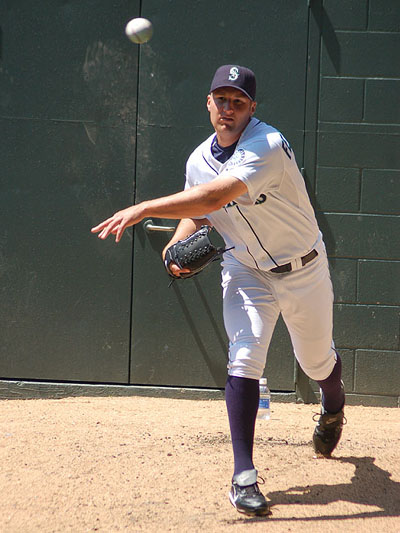
Ryan FeierabendThe trade deadline has come and gone for the Mariners, with only a minor deal shipping away Arthur Rhodes happening. The complete truth around the Jarrod Washburn trade rumors may never be known, but if I were the M's I would have given him away for fairly cheap (especially if the Yankees could have been coaxed into taking most of his salary). Now, the dog days of August are here, but thanks to the Morrow transition there is still some intrigue around this ballclub. There is also the potential for some more deals. As is pounded into everyone's head by sports media outlets these days, deals can be made after July 31. In fact, since the "trade deadline" rules for baseball are so mysterious, here is exactly how they work:
  1. July 31 is the last day in a season that players can be traded without passing through waivers. Without going into detail too much on the waiver process, basically a player can be placed on waivers at any time. When they are put on waivers, any team can put a "claim" on the player. If a player is claimed, then the current organization can let the player go and receive nothing in return. In this scenario, the new team must take on all of the player's remaining contract. However, if a player is claimed, the player can be pulled off of waivers and kept by the original team, or the player can be pulled from waivers and a trade can be worked out with the team that claimed the player. So, basically, July 31 is the last day during the season that trades can be made with complete freedom.
  2. September 1 is known best as the day that rosters can be expanded, but it is perhaps more important for another reason. Any players added to a team's 40-man roster after September 1 are not eligible for a team's post-season roster. That is why August 31 is considered a trade deadline of sorts, especially for teams in contention. September trades are extremely rare (the last one I can remember is when the Pirates traded Brian Giles to the Padres), but they can happen. Waiver rules for trades still apply in September.
  3. Once the off-season starts, the rules "reset" in a sense. In other words, players do not have to pass through waivers to be traded in the off-season, and can be moved without passing through waivers until after next July 31.
So, technically, there is no trade deadline in baseball at all. It is just convenient to think of a couple days as trade deadlines, because rules make July 31 and August 31 quasi-deadlines. Hopefully this clears up some confusion on what is a rather confusing set of rules, since the actual rules are rarely all stated together.

Anyway, the actual point of this post is not to just outline what the Mariners could do, but specifically what I would do if I were the Mariners interim GM right now. Any post-July 31 discussion must start with placing players on waivers. Here are the players I would put out there, and what I would hope/expect to happen:
  1. Kenji Johjima - His contract is horrible, and even though Jeff Clement is yet to light up major league pitching, he is a safe bet to be a better backstop than Johjima for the next three years. At the very least, Clement will be a much cheaper ineffective catcher. Given Johjima's bad contract, I would expect him to pass through waivers, and I also doubt anyone would want him in a trade. I wouldn't cut Johjima either, so in the end this waiver move is one that would probably never be known publicly. But, if a team does claim Johjima, I would let them take him, solely because I want to get his contract off the books. Why not test the waters risk-free, to see if some team will take Kenji's contract?
  2. Miguel Batista - I could copy what I just wrote for Johjima. Batista goes on the waiver wire for the same reasons: he is rather pricey, and rather ineffective. However, Miguel still has pretty good velocity, and he does have post-season experience, as well as considerable experience as a starter and reliever. Furthermore, his contract does not have as many years remaining as Kenji's, so it is not quite as bad. I still would not expect a team to claim Batista, but I think he has a much better chance of being claimed than Kenji. Once again, if a team claims him, I would let them have him. If Miguel passes through waivers, I would strongly consider releasing him.
  3. Miguel Cairo - I would much rather use Cairo's roster spot on an additional September call-up than on him for the remainder of the season. I do think there is a very good chance someone would claim him, and I would let him go. If he passes through waivers, then I would release him. I would call up Tug Hulett to replace Cairo, and add Matt Tuiasosopo to the 40-man roster, and call him up on September 1.
  4. Willie Bloomquist - Willie has stunningly little power, and he thinks he might be able to grab a starting job somewhere next year through free agency. Even though he is a local product, I think the chances of him leaving in the off-season are pretty good, and I would not be heart-broken since he brings absolutely no power to the table. However, a guy with his versatility, his speed, a .280 batting average, and .380 on-base may be appealing to a contender looking to bolster their bench for cheap. If Bloomquist were claimed, I would work out a trade with whomever claimed him, keeping in mind that there may be a compensatory draft pick coming if he is lost in free agency, given how much he has played this year.
  5. Jarrod Washburn - Washburn is probably the most interesting player waiver-wise the Mariners have. He was close to getting dealt at the deadline, so there is obviously some interest in him. If the Yankees were willing to take his whole salary at the deadline and it was the prospect package that held up the deal, they certainly would claim him on waivers. My suspicion is that some team would claim Jarrod, and if he is claimed, I would work out a trade. Of all the players I have on this list, I think a Washburn move is the most realistic.
Hypothetically, let's suppose that Cairo, Bloomquist, and Washburn are claimed, and that Cairo is allowed to go, a trade is worked out with the team that claims Washburn, and Bloomquist is pulled back from waivers and kept. This means that Kenji and Miguel passed through waivers. Given this hypothetical, this would be my plan through August:
  1. I already said that Tug Hulett would replace Miguel Cairo on the roster, so that was basically given in this scenario.
  2. A Bloomquist/Hulett platoon at shortstop could work surprisingly well, and I would recommend that Riggleman try it. In AAA, Hulett has destroyed righties but struggled against lefties (though in limited opportunities), while Willie has been noticably better against lefties this year. As much as I like Betancourt, he really needs to learn to take a few pitches, and I think a legitimate benching may be the best way to get across the message at this point.
  3. As a side note, especially with Bloomquist in a platoon at shortstop, I would put Jeremy Reed in left field, Ichiro back in center, and Balentien in right. Raul Ibanez stays in the lineup as the DH. This gets the two M's outfielders with best range in left and center (where Safeco field is most spacious), and the two M's outfielders with the strongest arms in center and right (where the longest outfield throws come from). That outfield alignment may do more for to improve the pitching than anything else.
  4. Getting rid of Washburn is key, because I want to take a look at Brandon Morrow, Ryan Rowland-Smith, and Ryan Feierabend as starters. I would call up Rowland-Smith to take Washburn's place, because I think he is the closest to ready (unless Erik Bedard is ready to come off the DL). Miguel Batista and R.A. Dickey are the next two out of the rotation once Feierabend and Morrow are ready, and to make room for both of them I would send down Jared Wells and and release Miguel Batista (the salary hit is easier to take with Washburn's contract off the books). If Erik Bedard gets healthy, I would strongly consider a six-man rotation the rest of the way, just to see RRS, Morrow, and Feierabend all get regular starts.
This is a very realistic hypothetical scenario, and could be executed by an interim GM. These are not moves that greatly alter the talent pool for future years, but do allow for better evaluation of prospects and a little more payroll flexibility. However, this is a team that held on to Jose Vidro until August, so I am not holding my breath.

Mariners Slowly Improving

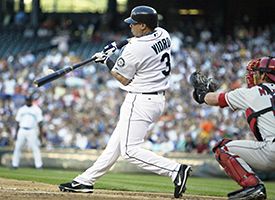
Jose VidroI went away on vacation over two weeks ago, and I just got back yesterday. I did not have any ridiculous hopes of some miraculous turn-around or amazing trade happening while I was away. However, I had a list of fairly realistic things that I hoped the Mariners would do while I was gone:

  1. Get rid of Jose Vidro
  2. Begin transitioning Brandon Morrow into a starter
  3. Trade Miguel Cairo and/or Willie Bloomquist
  4. Trade Jarrod Washburn and/or Miguel Batista
  5. Get rid of Jose Vidro
Admittedly, trades take a partner, so I realized wishes three and four may not happen even if the Mariners tried. From what I've gathered, Jarrod Washburn was quite close to being shipped ot the Yankees, but the Mariners had too high of an asking price. As disappointing as that was to hear, I was going to be quite upset if one, two, and five had not been taken care of. Thankfully, they were...though it took until the very last day of my vacation.

The timing of the moves really says something about the state of the organization right now. It is in better shape now, because I doubt the Bavasi/McLaren combo would have considered releasing Vidro, or moving Morrow from the bullpen. However, the current interim regime seems to have a hard time pulling the trigger on even the most obvious moves. I understand a reluctance to make major trades that would alter the franchise for years to come, given the interim status. However, everyone could tell that Vidro was not helping the ballclub now, and he certainly had no future with the team either.

The Morrow "conundrum" was even more pathetic. Supposedly, the organization as a whole was split on what to do with him. Those who wanted him to remain in the bullpen argued that there is no guarantee he will be as good as a starter, and that was apparently a good enough argument to keep him from transitioning for months. How pathetic is that? I happen to agree with the argument, yet also think that it is obviously the right move to try Morrow as a starter. This season is now all about evaluation, as even the Mariners have admitted. So, will there ever be a better time to try Morrow as a starter, and take the risk that he may be much worse as a starter than a reliever? Hopefully not.

At least the Mariners are getting better, but much too slowly. I understand that outside help through free agency and major trades has to wait until the off-season, once a permanent GM and manager are hired. However, there is no excuse for how long some of the blatantly obvious internal moves have taken. At least they finally were made, but whoever takes over next year needs to be more punctual.